A global perspective on blood banking and transfusion safety
Key Highlights
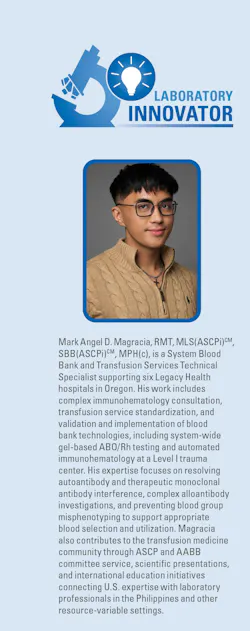
- Mark Angel D. Magracia specializes in complex immunohematology, transfusion safety, and blood bank technology implementation.
- His work supports transfusion service standardization and automated testing across six Legacy Health hospitals in Oregon.
- Magracia helps resolve complex antibody investigations and prevent blood group misphenotyping to support appropriate blood selection.
- Through professional service and international education initiatives, he works to expand access to transfusion medicine knowledge and training.
What inspired you to pursue a career in medical laboratory science and, ultimately, specialize in blood banking and transfusion medicine? How have your experiences working in both the Philippines and the United States shaped your career and your perspective on the laboratory profession?
I think a lot of medical laboratory scientists can relate to this: I honestly did not know what medical laboratory science was when I first entered college! I initially thought of it simply as a path toward becoming a doctor. During my first few weeks, though, we were introduced to what the profession actually does, and I became fascinated by the different areas of laboratory medicine. Microbiology, hematology, and blood banking quickly became my top three, but I eventually fell in love with blood banking. What attracted me was how specialized and intellectually challenging it could be.
In immunohematology, the answer is not always obvious. You have to understand the science, recognize patterns, and use critical judgment when the serology does not behave the way you expect. At the same time, the decisions we make at the bench can directly affect transfusion safety and patient care. I found that combination very fulfilling. My early blood banking career in the Philippines really molded me as a professional and gave me the foundation to become globally prepared. I consider those experiences a stepping stone to what I am able to do today in the United States, where I continue to encounter new technologies, complex cases, and different approaches to transfusion medicine. At the same time, I never want learning to be one-directional. One of the most fulfilling parts of my career now is being able to share what I have learned with fellow blood bankers, whether they are in the Philippines or the United States. The more I progress in my own career, the more I appreciate that knowledge becomes more valuable when you can pass it on to others.
What are some of the most challenging cases or problems you have encountered in complex immunohematology and transfusion medicine, and what have those experiences taught you about problem-solving, collaboration, and transfusion safety?
Some of my most memorable experiences as a blood banker have involved resolving warm and cold autoantibody interference, identifying unexpected alloantibodies in a geographically diverse patient population, and utilizing advanced testing in challenging cases, including cord blood studies. These are actually the cases I enjoy the most because they require attention to detail, connecting the dots, and looking beyond a single test result to understand the entire clinical and serologic picture. I have always believed in integrating knowledge with practice. Along with following institutional policies, I frequently go back to regulatory, accreditation, and technical resources because the theoretical foundation is important when you are trying to understand why something unexpected is happening.
One of the fascinating things about blood banking is seeing something in real life that you once thought you would only encounter in a textbook. Those experiences have taught me to examine every element of a case, from the reaction patterns and possible causes of interference to the patient’s transfusion history and previous testing before reaching a conclusion. Most importantly, I have learned that patient safety is not a one-person journey. I am a big believer in collaboration and teamwork. When I am uncertain, I am never afraid to consult colleagues, reference laboratories, or other experts and ask for their perspective. No matter how complex the investigation is or how much work goes into resolving it, I always come back to the same question: "How will what we are doing ultimately benefit the patient and make their transfusion safer?" That keeps the transfusion science connected to its real purpose.
You have been involved in laboratory validation and implementation as well as efforts to improve practices across different laboratory settings. What does successful implementation look like to you, and what lessons have you learned about translating new technologies, procedures, or practices into the day-to-day laboratory environment?
For me, successful implementation brings a real sense of professional satisfaction. When you validate something in the laboratory and eventually see it approved and incorporated into routine practice, it is a contribution you do not easily forget as a medical laboratory scientist. But I also believe it is not simply about the instrument, reagent, or method that you helped bring into the laboratory. What matters more is what that change can ultimately do for our patients.
A successful validation can lead to improved turnaround times, better analytical performance, more standardized testing, or even the ability to detect something that a traditional method may not have identified as clearly. In blood banking, it can also help eliminate unnecessary testing and prevent delays in transfusion care. Seeing the work you put into a validation, translates into measurable improvements in everyday laboratory practice and it is incredibly fulfilling because it demonstrates how our technical expertise can directly contribute to quality and patient safety.
One lesson I have learned through these experiences is to teach the principle, not just the instrument. Technology will continue to change, so implementation cannot end with teaching someone which buttons to press. Staff need to understand why a method works, its limitations, and what to do when a result does not behave as expected. To me, that is when implementation is truly successful: when a new technology or practice not only performs as intended, but also becomes something the laboratory team understands, trusts, and can use effectively to provide better patient care.
Education has become an important part of your work, from teaching and developing educational platforms to your upcoming AABB presentation on distance learning for blood banking education. What gaps in laboratory education have you observed, particularly in low- and middle-resource settings, and how do you see distance learning and other innovative approaches helping to address them?
I think one of the most pressing issues is not a lack of talented laboratory professionals, but a lack of access and exposure to advanced blood banking practices from a global perspective. As an immigrant from the Philippines, I experienced this firsthand. During my early career, many laboratories had limited access to such testings like phenotyping, direct antiglobulin testing and advanced immunohematology testing such as antibody identification, elution, and adsorption, and even antibody screening was not routinely available in every setting.
It was not because laboratory professionals lacked the ability or willingness to learn; often, the resources, training opportunities, and exposure simply were not there. That became even more meaningful to me during our recently completed Sustainable Blood Banking Education & Collaboration Program (SBBECP) in Manila last September 2026. One participant shared that their setting relied primarily on forward blood typing for transfusion testing, while another described crossmatching available units until a compatible unit was found. As a blood banker, you immediately start thinking about what could be behind that incompatibility, could it be an alloantibody, an autoantibody, or another serologic issue? But without access to additional testing and training, there may be limited opportunities to investigate further.
Hearing experiences like these remind me why we should never judge laboratories based solely on the resources available to them. This is where I believe distance learning can make a real difference, but education cannot stop with a single webinar or lecture. We need hands-on workshops, case-based learning, mentorship, and sustainable platforms that allow educators and participants to remain connected afterward. The goal is not to impose the practices of a high-resource setting on a lower-resource one. It is to share knowledge, strengthen local capability, and help laboratory professionals adapt what they learn to the realities of their own practice. Ultimately, I hope these collaborations can create a cycle where today's participants eventually become tomorrow's educators and mentors in their own communities.
Looking across your work as a laboratory professional, educator, and advocate for the field, what continues to motivate you to innovate and give back to the laboratory community?
I believe every patient deserves the highest quality of care we can provide, regardless of who they are, where they come from, or what part of the world they live in. In transfusion medicine, however, we know that differences in technology, resources, specialized testing, and access to education can influence what laboratories are able to provide for their patients. Having practiced in both the Philippines and the United States, I have experienced those differences personally. That is probably what motivates me most to give back. I want other blood bankers to have access to the knowledge, training, and opportunities that have helped me grow professionally, and ultimately, I want their patients to benefit from them.
I am a firm believer that safe transfusion should be universal. A patient's access to quality transfusion care should not be defined by geography or by how many resources their laboratory has. At the same time, I know that one person cannot solve those disparities. What I can do is contribute what I have learned, whether through a difficult case, a validation, a lecture, mentorship, or an educational program and make that knowledge useful to someone else. If that person can then apply it in their own laboratory and eventually share it with others, the impact becomes much greater than anything I could accomplish alone. That is what innovation means to me, it's not simply creating something new, but creating something useful that can be shared, sustained, and ultimately improve transfusion care for patients wherever they are.About the Author
 Christina Balsano