Artificial intelligence in laboratory information systems: Transforming the future of clinical diagnostics

Laboratory testing plays a very crucial role in patient care. Laboratory test results are believed to influence medical decisions by 70% or more.1,2 Laboratory testing not only helps in diagnosing patients’ ailments but also helps in planning treatments, managing chronic conditions, assessing treatment response, and developing new therapeutics. Central to the functioning of any modern clinical laboratory is the laboratory information system (LIS). The LIS was designed as a “turn-key” computer system that would allow control of daily processing of the laboratory. The system performs the following 15 major functions:3
1. Registration of test requests
2. Production of specimen collection sheets
3. Creating identification labels
4. Confirmation of specimen collection
5. Production of aliquot labels
6. Workload inquiry
7. Production of worksheets
8. Manual entry of test results
9. Automated entry of test results
10. Results inquiry
11. Generation of preliminary report
12. Generation of final report
13. Generation of daily activities reports
14. Generation of statistical reports
15. Billing
The following are benefits of the LIS: (a) reduced clerical work, (b) better evaluation of workload, (c) faster communication, (d) improvement of information given to the clinician [adapted reference values, interpretation, comments], (e) improved retrieval operations, and (f) faster billing.3
History and evolution of the laboratory information system
- Pre-1970s: Clinical testing records were handwritten logs, used manual calculations, and paper-based reporting. Work was labor-intensive, and the risk of transcription errors was high.4
- Late 1980s: First LIS system emerged that used a centralized on-premise, minicomputer to reduce transcription errors of sample analysis by automating reporting tools.4,5
- 1990s: Evolved to automate workflows and integrate directly with laboratory testing instruments. Commercial off-the-shelf (COTS) packages emerged, allowing for structured data management, quality control, and compliance tracking.5,6
- 2000s: Transitioned from proprietary, isolated systems to dynamic, web-enabled client/server architectures. This era marked the birth of early cloud-based platforms and heavy integrations with enterprise networks, barcode readers, and raw data systems.7
- 2010s: Transitioned from rigid, on-premise software to cloud-based, SaaS-model platforms. There was a shift toward mobile accessibility, the modernization of web portals, and handling massive datasets stemming from the genomics boom and high-throughput screening.7,8
- 2020s: Modern LIS operate as comprehensive Enterprise Resource Planning (ERP) tools. They are now incorporating Artificial Intelligence (AI) for predictive analytics, machine learning for automated result interpretation, and advanced data security to meet evolving HIPAA and global compliance regulations.5-9
Workflow of a typical LIMS
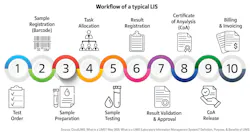
Impact of artificial intelligence in the laboratory information system
The emergence of artificial intelligence (AI) has redefined the LIS - enabling unprecedented levels of automation, accuracy, and clinical intelligence. Artificial intelligence (AI) encompasses a range of technologies — including machine learning (ML), deep learning (DL), natural language processing (NLP), and large language models (LLMs) — each finding a foothold in different domains of the LIS.9
The incorporation of AI in the LIS has transformed clinical laboratories and has helped to considerably enhance lab operations and decision making. Through integration with external AI-powered platforms, laboratories can now automate pattern recognition, optimize workflows, perform predictive modeling, and make informed decisions. These integrations allow labs to leverage machine learning algorithms for applications like anomaly detection, resource forecasting, and quality control analysis—streamlining complex processes without altering core LIS functionality.
AI-Powered LIS supports several key laboratory functions10
Enables predictive equipment maintenance: AI-powered LIS tracks usage and performance metrics of lab instruments so as to schedule maintenance proactively and minimize equipment downtime.
Detects substandard reagents: It monitors reagent quality and flags those that fall short of quality benchmarks, helping ensure data reliability.
Automates inventory replenishment: AI-powered LIS simplifies inventory control by triggering automatic purchase orders when supply levels drop, ensuring critical items are restocked on time.
Evaluates vendor performance: By storing and analyzing supplier data, AI-powered LIS aids in selecting dependable vendors, building consistent and trusted procurement relationships.
Establishes competitive pricing: It helps optimize pricing strategies by analyzing costs and market data, contributing to improved profitability.
Assesses staff performance: AI-powered LIS captures staff performance data—such as accuracy and speed—enabling comparisons and identifying areas for training and improvement.
How AI improves data analysis in the LIS
By connecting an LIS with AI-driven analytics tools, labs can extract deeper insights from large volumes of structured data. AI can help identify trends, outliers, and correlations that might otherwise go unnoticed. This empowers researchers and lab managers to make more informed decisions, enhance experimental design, and accelerate discovery while maintaining rigorous data integrity and traceability.
Because of this capability of AI, AI-powered LIS have become helpful in clinical operations and decision support.
AI-powered LIS in clinical operations and decision support
Autoverification and validation
AI within the LIS can perform automated review and release laboratory results without the intervention of a manual technologist. Traditional rule-based autoverification systems, guided by standards such as CLSI AUTO-10, use fixed thresholds for delta checks, critical values, quality control flags, and analytical error detection. However, these static rules are limited in their sensitivity and cannot adapt to complex, multivariate patient pattern.
AI validation in LIS ensures that machine learning algorithms and diagnostic tools are accurate, safe, and reliable before they go live. It involves evaluating model performance, data interoperability, and clinical utility against established laboratory benchmarks.
Predictive analytics and clinical decision support12-14
AI-enhanced LIS platforms are increasingly being integrated with clinical decision support systems (CDSS) to move beyond passive result reporting toward proactive diagnostic intelligence. Machine learning models embedded in or connected to the LIS can analyze patterns across thousands of patient records to predict clinical events such as sepsis, acute kidney injury, or deteriorating coagulation profiles before they reach critical thresholds. Risk stratification algorithms are being developed that combine laboratory results with demographic and clinical data to identify high-risk patients, enabling timely interventions.
Natural language processing of unstructured clinical data15
Clinical laboratories generate enormous quantities of unstructured data — pathologist narratives, microbiology culture comments, and free-text clinical notes — that traditional LIS platforms have struggled to process systematically. NLP is emerging as a critical tool for automating data capture, mapping clinical notes to terminologies, and extracting hidden insights. A 2024 systematic literature review in the Journal of Medical Internet Research documented the growing use of NLP combined with CDSS across 26 studies, demonstrating how AI-powered text mining can extract clinically actionable information from electronic health records (EHR)s, improving diagnostic accuracy and reducing cognitive burden on laboratory professionals. LIS platforms are beginning to incorporate NLP engines that can parse pathology reports, flag discrepant findings, and intelligently link narrative data to structured laboratory results.
Error detection and quality management16,17
Artificial intelligence transforms LISs by automating quality control, detecting pre-analytical errors, and utilizing machine learning for predictive modeling to flag anomalies in patient data. Integration of these AI error-detection models directly into the LIS workflow represents one of the most promising avenues for improving patient safety.
AI in anatomic pathology and digital imaging18
Beyond the clinical chemistry laboratory, AI is reshaping anatomic pathology through digital pathology platforms connected to the LIS. Deep learning algorithms can analyze whole slide images to detect malignant cells, grade tumors, and identify organisms in microbiology specimens. These systems do not replace pathologist judgment but serve as a powerful computational layer within the LIS reporting workflow.
The Future of the LIS in the age of artificial intelligence
The trajectory of AI in the LIS points toward a future of remarkable capability, though one must also navigate significant challenges in governance, interoperability, and workforce adaptation.
Cloud-native, interoperable AI platforms
The LIS of the future shows a rapid shift toward cloud-native microservices, interoperability via HL7/FHIR standards, and federated learning to ensure HIPAA-compliant, secure diagnostic workflows.19
Large language models and generative AI in the LIS20
Large language models (LLMs) and generative AI represent the next frontier of LIS intelligence. These models can engage in natural language dialogue with laboratory staff, draft interpretive comments for complex test panels, assist in literature-informed clinical interpretation, and support non-expert users in navigating laboratory data. The rapid maturation of multimodal AI — models that process text, images, and structured data simultaneously — will further extend these capabilities to encompass pathology imaging, genomic data, and mass spectrometry outputs within a unified LIS environment.
Autonomous workflows and staffing challenges
The United States Bureau of Labor Statistics projects more than 24,000 vacancies for clinical lab technologists every year for the next decade.21 AI-enhanced LIS platforms that can autonomously manage reflex testing, autoverification, quality control, and result interpretation will be essential to sustaining laboratory operations in this constrained workforce environment.
Challenges: Governance, ethics, and validation
The integration of AI into the LIS is not without challenges. Regulatory frameworks for AI-powered in vitro diagnostics remain immature in many countries, and the validation requirements for ML-based autoverification systems are still evolving. Bias in training data, lack of model explainability, and cybersecurity vulnerabilities in cloud-based architectures represent real risks. Laboratory professionals and pathologists must remain actively engaged in the governance and oversight of AI systems embedded in the LIS, ensuring that automated recommendations are auditable, transparent, and subject to regular performance review. The EU AI Act, fully effective through 2026, and evolving FDA guidance on AI/ML-based software as a medical device (SaMD) will shape the regulatory landscape for LIS-embedded AI in the years ahead.
Conclusion
The laboratory information system has undergone a remarkable evolution over six decades — from punched-card mainframe interfaces to cloud-based, AI-enhanced diagnostic platforms. Artificial intelligence is now permeating every functional layer of the LIS: from autoverification and quality management to clinical decision support, NLP-driven narrative processing, and digital pathology interpretation. The data suggests that the pace of AI integration into laboratory informatics will only accelerate. For laboratory managers and pathology informaticists, the imperative is clear: invest in data quality and standardization now, engage proactively in AI governance frameworks, and champion the role of laboratory professionals in the design and oversight of intelligent systems. The LIS of tomorrow will not merely store and report results — it will think, predict, and act as an active partner in the delivery of precision medicine.
References
- Morice W II. 4 statistics that showcase the broad impact of laboratory medicine. Mayo Clinic Laboratories. Accessed July 13, 2026. https://news.mayocliniclabs.com/2025/04/21/4-statistics-that-showcase-the-broad-impact-of-laboratory-medicine/.
- Hicks AJ, Carwardine ZL, Hallworth MJ, Kilpatrick ES. Using clinical guidelines to assess the potential value of laboratory medicine in clinical decision-making. Biochem Med (Zagreb). 2021;31(1):010703. doi:10.11613/BM.2021.010703.
- Forest JC, Rheault C, Dang-Vu TK. The laboratory information system (LIS): I-Application to the clinical chemistry laboratory. Clin Biochem. 1985;18(2):78-84. doi:10.1016/s0009-9120(85)80085-0.
- Prasad PJ, Bodhe GL. Trends in laboratory information management system. Chemometr Intell Lab Syst. 2012;118:187-192. doi:10.1016/j.chemolab.2012.07.001.
- Cudiamat G. Market profile: Laboratory information management systems (LIMS). LCGC North America. 2019;37(11). Accessed July 13, 2026 from: https://www.chromatographyonline.com/view/market-profile-laboratory-information-management-systems-lims.
- What is LIMS? Guide to lab information management systems. Revol LIMS. Accessed July 13, 2026. https://revollims.com/what-is-a-lims#.
- Quillen T. The evolution of LIMS: From legacy systems to cloud-based solutions. LIMSey. July 10, 2024. Accessed July 13, 2026. https://www.limsey.com/blog/evolution-of-lims-from-legacy-to-cloud-based-solutions/.
- History and future LIMS (Laboratory information management systems). LabInsights. Updated October 29, 2024. Accessed July 13, 2026. https://labinsights.nl/en/article/history-and-future-lims-laboratory-information-management-systems.
- Pillay TS, Topcu Dİ, Yenice S. Harnessing AI for enhanced evidence-based laboratory medicine (EBLM). Clin Chim Acta. 2025;569:120181. doi:10.1016/j.cca.2025.120181.
- What is a LIMS. CloudLIMS. July 7, 2026. Accessed July 13, 2026. https://cloudlims.com/what-is-a-lims/.
- Yang WH, Yang YJ, Hou CY, Huang CP, Chen TJ. Implementation of an AI-driven auto-verification system: Improving laboratory efficiency in rural Taiwanese hospitals. Research Square. Published online 2025. doi:10.21203/rs.3.rs-5934891/v1.
- Oei SP, Bakkes THGF, Mischi M, et al. Artificial intelligence in clinical decision support and the prediction of adverse events. Front Digit Health. 2025;7:1403047. doi:10.3389/fdgth.2025.1403047.
- Waldock WJ, Guni A, Darzi A, Ashrafian H. Performance of predictive AI-based clinical decision support systems across clinical domains: A systematic review and meta-analysis. PLOS Digit Health. 2026;5(3):e0001310. doi:10.1371/journal.pdig.0001310.
- Dodig S, Čepelak I, Dodig M. Are we ready to integrate advanced artificial intelligence models in clinical laboratory? Biochem Med (Zagreb). 2025;35(1):010501. doi:10.11613/BM.2025.010501.
- Eguia H, Sánchez-Bocanegra CL, Vinciarelli F, Alvarez-Lopez F, Saigí-Rubió F. Clinical decision support and natural language processing in medicine: Systematic literature review. J Med Internet Res. 2024;26:e55315. doi:10.2196/55315.
- May P, Nokodian S, Nuernbergk C, et al. Artificial intelligence-assisted error detection in complex clinical documentation: Leveraging large language models to enhance patient safety in oncology. JCO Clin Cancer Inform. 2026;10:e2500194. doi:10.1200/CCI-25-00194.
- Warade J. AI based predictive modelling for internal quality control: A machine learning approach using Altair RapidMiner. EJIFCC. 2025;36(4):491-498.
- McGenity C, Clarke EL, Jennings C, et al. Artificial intelligence in digital pathology: a systematic review and meta-analysis of diagnostic test accuracy. NPJ Digit Med. 2024;7(1):114. doi:10.1038/s41746-024-01106-8.
- The future of healthcare integration in 2026: From data exchange to intelligent workflows. Emorphis Health. Accessed July 13, 2026. https://emorphis.health/blogs/future-of-healthcare-integration-technology/.
- Ghnemat R, Saleh A. Large language models for clinical artificial intelligence in healthcare a systematic review. Discov Artif Intell. 2026;6(1). doi:10.1007/s44163-025-00784-x.
- Schur M. Building tomorrow’s lab workforce. June 10, 2025. AMT. Accessed July 13, 2026. https://americanmedtech.org/blog/blog-post/building-tomorrows-lab-workforce.
About the Author
 Rajasri Chandra, MS, MBA
Rajasri Chandra, MS, MBA
is a global marketing leader with expertise in managing upstream, downstream, strategic, tactical, traditional, and digital marketing in biotech, in vitro diagnostics, life sciences, and pharmaceutical industries. Raj is an orchestrator of go-to-market strategies driving complete product life cycle from ideation to commercialization.