Molecular diagnostics in 2026: Labs balance expanding capabilities with practical realities
Key Highlights
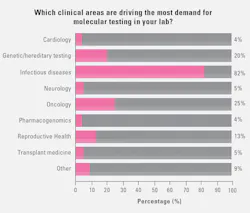
- Infectious disease leads demand for molecular and multiplex testing, cited by 82% and 81% of respondents, respectively.
- Labs report a range of multiplex approaches, from single-analyte tests to panels covering 10 or more analytes.
- Supply constraints have eased substantially since 2022, though sourcing issues persist for reagents, culture media, and other supplies.
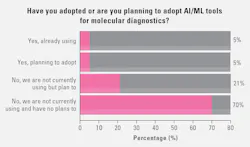
- AI/ML use remains uncommon: 70% of respondents say their labs neither use these tools nor plan to adopt them.
- Staffing shortages, rising operating costs, and uncertain reimbursement continue to challenge laboratory sustainability.

It is that time of year again – the results of the 2026 MLO MDx State of the Industry Survey (SOI) are in! This year’s survey garnered responses from 94 medical laboratory professionals on topics around molecular diagnostic testing modalities and trends, including respiratory testing, clinical areas driving MDx test demand, supply chain challenges, quality assurance practices, and artificial intelligence (AI) adoption. New for this year, MLO queried lab professionals on multiplex molecular testing trends.
We present the quantitative survey results alongside commentary from medical laboratory professionals and vendors in the MDx space.
Respondent roles changed little compared with last year’s survey results, with 51% working in Lab Manager, Administrator, Supervisor, or Lab Director positions. Medical Laboratory Scientists (MLS) accounted for 18% of respondents, compared with 17% in 2025. As in past years, hospital/health system labs represented the largest employment setting among respondents at 59%, up from 51% in 2025.
4 key 2026 survey findings:
- Infectious disease continues to lead molecular testing demand, cited by 82% of respondents, up from 77% in 2025.
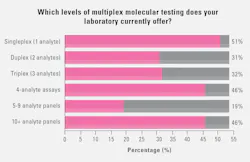
- Survey respondents report a broad mix of multiplex approaches, from singleplex (51%) to 10+ analyte panels (46%).
- Supply availability continues to improve, with 22% reporting supply shortages have impeded testing capacity, down from 85% in 2022.
- AI/ML adoption remains limited, with 70% reporting no current use and no plans to adopt these tools.
Molecular testing volumes and respiratory testing trends
Most respondents (67%) report their labs performing between 0-100 molecular-based tests (non-COVID) daily, with the second highest reported testing volume – 101-200 tests daily – following far behind at 16%. Only 9% report 400+ tests daily, down from 17% in 2025, and 22% in 2024.
Nearly half of lab professionals surveyed (45%) report a 0-25% increase in respiratory testing in 2026. The next highest percentage of respondents (17%) reported a decrease in respiratory testing this year, down from 24% in 2025, and matching the 17% reported in both 2024 and 2023.
Evolving respiratory testing needs
QuidelOrtho Senior Director of Scientific Affairs Kevin King, PhD shared his perspectives on respiratory testing trends, the drivers behind them, and the technology platforms to support molecular testing in this category.

“Respiratory testing needs are shifting from seasonal spikes to year-round demand, driven in part by viruses like rhinovirus and enterovirus that circulate without a defined season,” said King. “The year-round demand is also changing how labs choose molecular approaches.”
“Turnaround time is increasingly important, especially in emergency and urgent care settings where results can inform decisions about isolation, treatment, or discharge,” he continued. “Workforce constraints are leading more labs to consider CLIA-waived platforms that enable testing by a broader range of healthcare personnel. And, as testing moves closer to the patient, integration with the LIS and public health reporting is becoming a bigger factor in platform selection, since results that do not reach those systems may limit visibility.”

Hologic Manager, Scientific Affairs, Richard Smith described how unpredictable surges can challenge systems and pointed to automation/high-throughput capabilities in MDx testing modalities as one response.
“Take respiratory season for example,” said Smith. “The traditional concept of a predictable respiratory season is fading as respiratory pathogens increasingly circulate year-round and can surge unexpectedly. During periods of elevated demand, systems that require significant hands-on time may struggle to keep pace, forcing laboratories to reprioritize testing or allocate additional resources. Automated, high-throughput molecular platforms help laboratories maintain workflow efficiency while meeting fluctuations in demand.”
The role of rapid antigen testing
SEKISUI Diagnostics Senior Manager, Commercial Marketing, Jeff Reid pointed out how molecular isn’t the only tool for respiratory testing, explaining where rapid antigen testing plays a role in the diagnostics continuum.

“While molecular respiratory testing remains the gold standard for diagnostic accuracy, rapid antigen testing continues to play an important role in respiratory disease management by delivering actionable results at the point of care within minutes,” said Reid. “Most rapid antigen tests have good sensitivity and high specificity, giving clinicians accurate results and allowing them to make immediate decisions regarding patient isolation, antiviral treatment, and infection control, particularly in urgent care facilities and physician offices.”
When deciding between a rapid antigen test and a molecular test, Reid recommends that laboratories and healthcare providers consider several factors, including the clinical setting, patient risk level, desired turnaround time, and the confidence needed to guide treatment decisions.
“Rapid antigen tests remain valuable when immediate results are needed to support patient triage, isolation decisions, or workflow efficiency,” said Reid. “They are often used in settings where speed and accessibility are critical. Antigen testing can provide a practical first-line option during periods of high respiratory virus activity.”
“However, molecular testing is often preferred when diagnostic accuracy is particularly important,” Reid added. “This includes patients who may be at higher risk for complications, situations where treatment decisions depend on a definitive diagnosis, or when distinguishing among multiple respiratory pathogens is essential. Molecular testing can help reduce the risk of false-negative results and provide greater confidence in clinical decision-making.”
Infectious disease drives molecular and multiplex testing demand
Topping the list of molecular diagnostic tests reportedly used by respondents’ labs was rapid molecular at 55% (up from 52% in 2025), followed by reverse transcriptase quantitative polymerase chain reaction (rRT-qPCR) at 47% (down from 54% in 2025), and rapid antigen at 42% (down from 48% in 2025).
Further down the list were DNA/genetic testing at 17% (up from 11% in 2025), flow cytometry at 14% (same as 2025), digital PCR at 12% (which was new for this year), and next-generation sequencing (NGS) at 12% (up from 10% in 2025).
Smith described how molecular diagnostic technologies are helping laboratories address many of the challenges faced today, including pressures around turnaround time, staffing, workflow efficiency, and increasing clinical expectations.
“Automated molecular testing can enable true walk-away workflows, allowing laboratory professionals to multitask and focus on high-value activities such as quality oversight, result interpretation and customer service rather than manual test and instrument management,” said Smith. “Higher-throughput analyzers can provide continuous random-access testing and scalable processing, enabling laboratories to absorb testing surges without extending time to result.”
Where demand is coming from
When asked which clinical areas were driving the most demand for molecular testing in their labs, by far the highest response was infectious diseases at 82% (up from 77% in 2025), followed by oncology at 25% (up from 22% in 2025) and genetic/hereditary testing at 20% (up from 13% in 2025).

Laboratory of Florida (LabFlorida) President and CEO Andrei Leonov shared his perspective on the demand for molecular diagnostics and the factors driving that demand. Based in Tampa, Florida, LabFlorida is a specialty laboratory serving assisted living residents and homebound patients across 15 states, primarily Medicare beneficiaries.
“Demand for molecular diagnostics is strong, particularly for suspected recurrent and complicated urinary tract infections, where timely treatment with specific antibiotics is critical,” said Leonov. “Our ordering providers have embraced same-day molecular results, paired with antibiotic resistance gene testing, to support more informed treatment decisions. For these vulnerable patients, faster answers can help reduce unnecessary antibiotic exposure and prevent hospitalizations.”
Multiplex demand
For 2026, MLO asked medical laboratory professionals questions on clinical demand for multiplex molecular testing and level of this testing used in their labs. As with the broader category of molecular testing, survey respondents reported infectious diseases as the largest driver of multiplex molecular test usage at 81%, followed by oncology at 15%, and genetic/hereditary and reproductive health, both at 7%.
Turning to the levels of multiplex molecular testing labs currently offer, just over half of survey respondents (51%) reported offering singleplex (1 analyte), while 46% offer 4-analyte assays, and 46% 10+ analyte panels. This was followed by triplex (3 analytes) at 32%, duplex (2 analytes) at 31%, and 5-9 analyte panels at 19%.
Targeted versus multiplex testing
Smith commented on how laboratories must balance clinical value, operational impact and financial considerations when evaluating targeted assays versus broad multiplex panels.
“A logical starting point is understanding the population being served,” said Smith. “Factors such as the inpatient versus outpatient mix, the prevalence of immunocompromised patients, and the presence of individuals from settings that require enhanced infection control, such as long-term care facilities, can significantly influence testing needs.”
“Broad multiplex panels provide rapid, comprehensive pathogen detection and can be particularly valuable for high-acuity inpatients and high-risk populations,” Smith continued. “Targeted assays offer a more tailored, patient-centered approach, allowing testing to align with an individual's symptoms, risk factors, and clinical history. Both play an important role in delivering actionable results. The optimal testing strategy is one that supports both patient care and long-term laboratory sustainability.”
“At the same time, responsible testing and diagnostic stewardship are critical,” Smith added. “Laboratories must balance the need for actionable results with the need to avoid unnecessary testing while remaining prepared for emerging, surging, and atypical infections. Higher-throughput analyzers with broad testing menus can support laboratory consolidation, improve resource utilization, and help control costs.”
Reimbursement pressures impact molecular testing
One survey respondent’s write-in response illustrates how reimbursement can factor into decisions about MDx testing levels. When asked which clinical areas are driving the most demand for multiplex molecular testing in their lab, the lab professional wrote, “None – no longer getting reimbursed so changing back from multiplex to singleplex.”
Leonov raised the issue of reimbursement in his comments around MDx testing. He stated, “Sustaining access to this testing is becoming increasingly difficult. CPT coding uncertainty, inconsistent payer interpretations, and the lack of a clear, reliably reimbursed pathway for direct-from-specimen antibiotic resistance panels leave laboratories unable to predict whether clinically requested services will be paid. Threatened reimbursement cuts compound that uncertainty while operating costs continue to rise.”
“For independent laboratories like ours, this threatens the financial viability of services that providers depend on,” Leonov added. “Policymakers and payers must consider the total cost of care: Savings on a laboratory claim can be overwhelmed by the cost of even one avoidable hospitalization. Clear coding guidance and sustainable reimbursement are essential to preserving access.”
Supply chain pressures ease – but haven’t disappeared
Looking back on five years of MLO MDx State of the Industry Survey (SOI) data, respondents continue to report fewer supply chain constraints than during the pandemic. In 2026, 22% of lab professionals surveyed reported that a lack of testing supplies had impeded their testing capacity at times, down from 29% in 2025, 38% in 2024, 53% in 2023, and 85% in 2022. Meanwhile, 78% reported having adequate testing supplies.
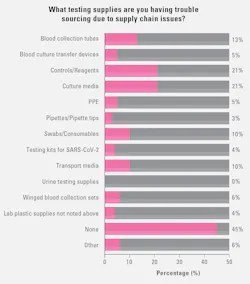
But supply chain challenges haven’t disappeared among this year’s respondents. When questioned on the availability of specific supply categories, 21% of survey respondents reported trouble sourcing controls/reagents and culture media, with culture media showing a sharp increase, up from 8% of respondents in 2025.
Medical laboratory professionals also reported sourcing issues with blood collection tubes (13% in 2026, down from 17% in 2025), swabs/consumables (10% in 2026, up from 7% in 2025), and transport media (10% in 2026, up from 1% in 2025).
The 6% of survey respondents who chose “other” as their response cited trouble sourcing PCR kits, RSV/flu kits, Chloroprep, gloves, and chemicals.
Quality practices remain a focus in molecular testing
Most laboratory professionals report their labs participate in proficiency testing for molecular assays, with 48% participating through the American Proficiency Institute (API) and 45% through the College of American Pathologists (CAP), while 15% report not participating in molecular assay proficiency testing.
When asked how they handle questionable results with molecular tests, 78% of those surveyed report repeating the test (up from 50% in 2025), 70% verify all pre-analytical, analytical, and/or post-analytical steps are performed correctly (up from 22% in 2025), 37% repeat the test with a different employee, equipment or test (up from 16% in 2025), and 22% send results to another lab for verification and a second test (up from 4% in 2025).
To reduce the number of false positive test results, 68% of laboratory professionals report decontaminating the work/test area per laboratory procedures (up from 67% in 2025), 65% verify all pre-analytical, analytical, and/or post-analytical steps are performed correctly (down from 90% in 2025), 41% repeat the test with the same sample and new extractions (down from 62% in 2025), and 35% refer to quality assurance program guidance (down from 39% in 2025).
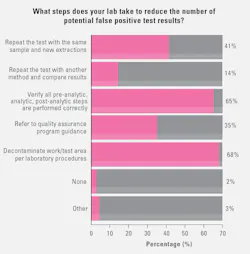
The 3% of respondents who selected “other step not listed,” cited monthly contamination testing and identifying a super-user tech competently trained on molecular technologies as methods for reducing the number of false-positive test results.

Clarity Labs Laboratory Manager Alan Calaor emphasized that a positive molecular result does not necessarily indicate active disease. Because molecular assays may detect residual genetic material from previous infections after antimicrobial treatment or immune clearance, he said results should be evaluated in the context of factors such as microbial quantity, specimen type, and anatomical source.
“To prevent overinterpretation, molecular findings should be correlated with culture whenever the organism is cultivable and appropriate for safety and clinical reasons,” said Calaor. As one example, he noted that “the degree of growth should be reported using appropriate laboratory measures, such as colony-forming units per milliliter (CFU/mL) for urine. Clinical symptoms, specimen quality, inflammatory findings, and anatomical location should also be considered.”
He also noted that, when appropriate, culture can complement molecular testing by confirming growth, identifying organisms not included in molecular panels, and providing antimicrobial susceptibility results.
AI remains on the horizon for most laboratories
Despite the growing attention around AI in healthcare, adoption of AI/ML tools for molecular diagnostics remains limited among this year’s survey respondents.
Nearly three-quarters of respondents (70%) report they are not currently using these tools and have no plans to use them (70% in 2026, up from 67% in 2025). Only 5% of survey respondents report their labs using AI/ML tools in molecular testing (down from 6% in 2025), 5% report they are planning to adopt (down from 8% in 2025).
One data point points to the potential for greater AI/ML adoption in the MDx testing arena: 21% of lab professionals surveyed report they are not currently using AI/ML tools but plan to adopt them in the future, up from 19% in 2025.
Conclusion: Opportunities exist yet operational challenges remain
While greater automation in MDx testing may help address some laboratory operational pressures, challenges such as staffing and rising costs remain. Leonov described how these pressures are affecting his laboratory.
“Staffing remains a major operational challenge in the Tampa Bay area,” said Leonov. “Too few local schools offer medical laboratory science programs, and those programs struggle to attract students interested in pursuing the profession. The resulting shortage of qualified medical laboratory scientists makes recruiting difficult and increasingly expensive.”
“At the same time, the increases we see in our own operating costs substantially exceed published inflation rates,” Leonov added. “Maintaining skilled staffing, testing quality, and same-day turnaround requires sustained investment, yet reimbursement does not reliably reflect those costs. Preserving the rapid turnaround times and personal service our patients and providers depend on, while keeping the operation financially viable, is becoming increasingly challenging.”
What’s ahead for molecular testing at the point of care
QuidelOrtho Senior Director of Scientific Affairs Kevin King, PhD, expects ultra-rapid, CLIA-waived molecular testing at or near the point of care to have a significant impact on clinical laboratories over the next several years, stating, “Published research found that rapid molecular testing for respiratory viruses cut median turnaround time from over 26 hours to under three and was associated with reduced hospital admissions and more patients receiving results before leaving in the studied population.”1
As testing moves closer to the patient, King noted how the central lab role may evolve from high-volume production toward oversight, quality management and training across decentralized sites.
“Investment in platforms that detect multiple respiratory pathogens from a single sample may also support year-round surveillance efforts, helping labs and health systems monitor for surges across seasons,” King commented. “Labs that successfully integrate point-of-care testing into their broader quality and data infrastructure may be well positioned to realize potential benefits of decentralization while managing quality assurance, contamination control, and regulatory changes.”
Reference
- Wabe N, Li L, Lindeman R, et al. The impact of rapid molecular diagnostic testing for respiratory viruses on outcomes for emergency department patients. Med J Aust. 2019;210(7):316-320. doi:10.5694/mja2.50049.
About the Author
 Kara Nadeau
has 20+ years of experience as a healthcare/medical/technology writer, having served medical device and pharmaceutical manufacturers, healthcare facilities, software and service providers, non-profit organizations and industry associations.