Pre-analytical automation market boosted by growing laboratory automation adoption
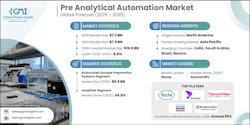
The global pre-analytical automation market was valued at USD 7.3 billion in 2025 and is positioned for strong expansion over the next decade. According to the latest report published by Global Market Insights Inc., the market is projected to grow from USD 7.9 billion in 2026 to USD 16.6 billion by 2035, registering a compound annual growth rate (CAGR) of 8.6% during the forecast period. This robust growth trajectory reflects the increasing adoption of automation technologies across clinical laboratories and diagnostic facilities worldwide.
Market expansion is primarily driven by the rising demand for laboratory automation. As healthcare systems face mounting diagnostic workloads, laboratories are under pressure to enhance operational efficiency, reduce manual errors, and ensure faster turnaround times. Pre-analytical automation systems streamline critical processes such as sample collection, labeling, preparation, transport, and storage—areas traditionally prone to variability and human error.
Increasing test volumes in clinical diagnostics further accelerate market growth. The growing burden of chronic diseases, expanding preventive screening programs, and heightened awareness of early disease detection are significantly increasing laboratory workloads. Automation solutions help laboratories manage higher throughput while maintaining accuracy and compliance with regulatory standards.
Additionally, growing investments in clinical laboratories aimed at improving workflow efficiency and reducing reporting times are supporting widespread adoption of pre-analytical automation systems. Healthcare providers are prioritizing infrastructure modernization to enhance diagnostic precision and patient outcomes.
Based on product type, the global pre-analytical automation market is segmented into automated sample preparation systems, automated sample transport systems, automated sample sorting systems, automated sample storage systems, and other product types.
The automated sample preparation systems segment accounted for the leading share of 39.5% in 2025. The increasing need for faster turnaround times and standardized sample processing is a key factor fueling segmental growth. These systems minimize manual handling, reduce contamination risks, and improve reproducibility across high-volume laboratory environments. The segment is expected to reach USD 6.9 billion by 2035, expanding at a CAGR of 9.1% during the forecast period, reflecting strong demand for integrated and high-throughput preparation platforms.
Based on end use, the market is segmented into hospitals, clinical laboratories, research institutes, and other end users. The hospitals segment accounted for the largest market share of 45.8% in 2025. Hospitals are increasingly adopting pre-analytical automation solutions to manage rising inpatient and outpatient diagnostic demands. Automation enhances sample tracking, reduces turnaround times, and supports seamless integration with laboratory information systems, making it a strategic investment for hospital-based laboratories.
Clinical laboratories and research institutes are also witnessing steady adoption, particularly as diagnostic volumes grow and precision requirements become more stringent.
North America dominated the global pre-analytical automation market, accounting for 38.6% of the total market share in 2025. The region’s leadership is supported by advanced healthcare infrastructure, high diagnostic testing volumes, and early adoption of laboratory automation technologies. Continued investments in laboratory modernization and stringent regulatory frameworks are further strengthening regional market growth.
In the U.S., the market was valued at USD 2.1 billion in 2022 and USD 2.3 billion in 2023. The market grew to USD 2.4 billion in 2024 and reached USD 2.6 billion in 2025. It is projected to expand steadily over the forecast period, driven by the rising use of automation in sample tracking and logistics. Healthcare institutions across the country are increasingly integrating automated workflows to reduce operational inefficiencies and enhance diagnostic accuracy.
Overall, the global pre-analytical automation market is poised for sustained growth through 2035. As diagnostic workloads intensify and healthcare systems prioritize efficiency, automation in the pre-analytical phase will become increasingly critical. Continuous technological innovation, expanding clinical testing volumes, and growing investments in laboratory infrastructure are expected to maintain strong demand for advanced pre-analytical automation systems, supporting the next generation of streamlined and high-performance diagnostic workflows.
About the Author
 LABline