
MLO’s 2026 Annual Salary Survey, completed by 406 laboratory professionals, reveals a highly experienced and educated workforce that remains essential to patient care but continues to face questions about staffing, compensation, career development, and long-term workforce sustainability.
Three findings stand out:
- Compared with last year’s survey, the respondent pool is increasingly experienced and leadership focused. More than half were age 56 or older, nearly half had worked in the laboratory industry for more than 30 years, and laboratory leaders represented a substantially larger share of respondents than in 2025.
- Reported salaries rose, but confidence in career advancement weakened. Nearly three-quarters expected to earn at least $75,000, yet only 31% believed they had adequate advancement opportunities.
- Workforce pressures persist. Nearly eight in 10 respondents reported difficulty hiring qualified staff, 76% experienced moderate or high turnover, and 63% said personnel shortages had a moderate or large operational impact.
Survey comments and interviews with laboratory professionals - Angela Tomei Robinson, MS, MLS(ASCP)cm, retired associate administrator of pathology and laboratory medicine and laboratory advocate; and Jordyn Justice, MLS(ASCP), medical laboratory scientist at Levine Cancer Institute - add insight into what the numbers mean for compensation, retention, education, and the future of the profession.
A look at the respondents
As in previous years, most respondents were female (79%) and worked in hospital or health system laboratories (67%). However, the 2026 respondent pool was notably more senior than in 2025 in terms of position, age, and experience.
Laboratory directors, managers, administrators, and supervisors represented 41% of respondents, up from 28%, while medical laboratory scientists (MLS/MS) increased from 12% to 19%. In contrast, medical laboratory technician (MLT) representation fell sharply, from 33% to 6%.
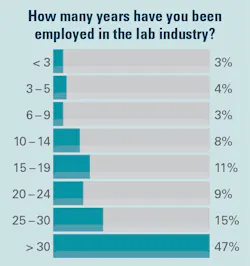
More than half of respondents (52%) were age 56 or older, compared with 33% in 2025. Nearly half (47%) had worked in the laboratory industry for more than 30 years, up from 30%, while the percentage with fewer than 10 years of experience declined from 32% to 10%.
Current workplace
Respondents represented laboratories of varying sizes and testing volumes. The highest percentage (41%) work in labs with 20 or fewer employees, while 22% work in labs employing more than 100 people. Annual testing volumes were similarly diverse: 37% worked in laboratories performing more than 1 million tests annually, while 20% reported volumes between 100,001 and 500,000 tests.
Compared with 2025, respondents were more established with their current employers. The percentage with fewer than 10 years of service declined from 60% to 41%, while the share employed by the same organization for at least 20 years increased from 23% to 36%. Those with less than three years of tenure fell by nearly half, from 25% to 13%.
Standard eight-hour shifts became more common, reported by 61% of respondents compared with 52% in 2025. Meanwhile, 12-hour shifts declined from 11% to 4%, and 10-hour shifts fell from 20% to 15%.
A new question examined the average number of hours worked per week, finding 80% of respondents working at least 40 hours, including 42% who exceeded 40 hours. More than one-third (36%) reported working 41–50 hours per week, and 6% worked more than 50 hours.
Education and certification
Education levels shifted upward from 2025 to 2026, with respondents holding bachelor’s degrees increasing from 46% in 2025 to 58% in 2026, and those with associate degrees falling from 33% to 12%. Those holding post-graduate degrees increased slightly, at 28%, up from 22%, while those saying high school was their highest level of education increased slightly from .03% in 2025 to 1.27% in 2026%.
American Society for Clinical Pathology (ASCP) remained the most commonly reported professional certification, held by 68% of respondents (73% in 2025). The most notable year-over-year change was in Medical Laboratory Technician (MLT) certification, which fell from 35% to 15%.
Conversely, the percentage reporting medical laboratory scientists (MLS/MS) certification increased from 17% to 27%, while medical technologist (MT) certification rose from 23% to 32% and clinical laboratory scientists (CLS) certification increased from 11% to 14%.
The changes point to a respondent pool more heavily represented by medical laboratory scientists and technologists and less represented by medical laboratory technicians (MLT). This is consistent with fewer MLT respondents this year compared with last year.
As for the organizations from which they received professional certifications, there was little change from 2025 to 2026, with the majority (72%) reporting the American Society for Clinical Pathology (ASCP), 10% American Medical Technologists (AMT), 10% the National Credentialing Agency for Laboratory Personnel (NCA) and 13% selecting “my state.”
Salaries, bonuses, and benefits
The salaried versus hourly percentage of respondents reversed year-over-year with salaried respondents increasing from 36% in 2025 to 49% in 2026, while hourly respondents fell from 64% to 51%. However, this may reflect the higher number of laboratory professionals in leadership positions taking part in the 2026 survey.
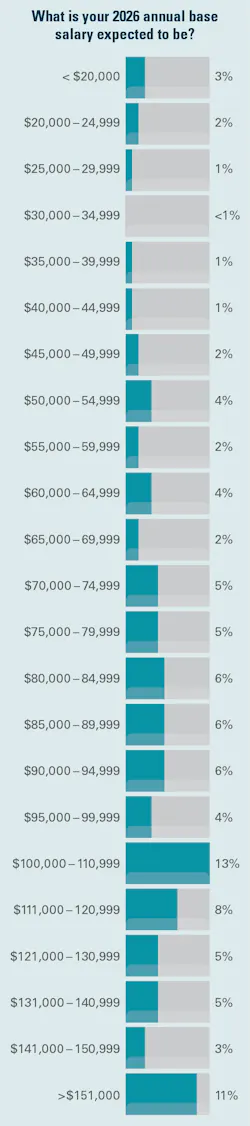
Salary growth remained widespread, with 73% reporting an increase last year (up from 68%), 26% no change in salary (down from 29%), and only 1% reported a decrease (down from 3%). Nearly half of respondents (45%) expect to earn at least $100,000 in 2026, compared with 26% in 2025.
Overall, 72% expect salaries of $75,000 or more, up from 52%. At the same time, the percentage in the $50,000-$74,999 range fell from 32% to 17%, while those earning between $20,000 and $49,999 declined from 15% to 6%.
As with the salaried versus hourly findings, the higher salaries may reflect the greater number of laboratory directors, managers and supervisors; and bachelor’s- and postgraduate-degree holders; and fewer MLTs and associate-degree holders taking part in the survey this year compared with last year.

Robinson and Justice stressed the importance of looking beyond the numbers to whether pay reflects professional qualifications.
“Compensation should always be commensurate with education and experience,” said Robinson. “And salaries have improved where there are bidding wars with competition for supply and demand of qualified board-certified medical laboratory professionals. But unfortunately, not everywhere and need this nationwide.”
“I do not believe that the current national average salaries for medical laboratory professionals accurately reflect the educational background we hold and responsibilities we take on each day,” said Justice. “We are required to have specific educational backgrounds, certification/license, and specialized clinical skills. These all equate to a higher compensation that isn’t offered to us.”
Most respondents anticipate a modest salary increase in 2026, with 55% expecting a raise of 2%-4%, up from 44% in 2025, while the other raise categories changed relatively little. Bonuses became less common with only 26% of respondents reporting they received a bonus last year, down from 32%).
Employer benefit offerings remained robust year-over-year, with most laboratory professionals surveyed receiving health insurance (96%), dental insurance (90%), a 401k or pension plan (90%), vision insurance (88%), PTO (84%) and life insurance (81%). Nearly three-quarters (74%) reported receiving disability insurance, 68% paid holidays, 59% employee assistance program and tuition reimbursement, and 51% overtime pay.
Job satisfaction, security and advancement opportunities
Overall job satisfaction improved modestly, with those reporting to be “very satisfied” or “somewhat satisfied” increasing to 84% in 2026, from 79% in 2025. However, looking at the “very satisfied” responses in isolation, this fell to 31% from 38%, while the “somewhat satisfied” responses rose to 53% from 41%.
When asked for the primary reason for staying in their current position, more than half (53%) chose location/commute (52% in 2025), followed by salary (42%, up from 38%) and benefits (42% up from 39%), work/life balance (41% down from 47%), team/culture (38%, same as 2025), job security (32%, same as 2025), and lack of other opportunities (16%, same as 2025).
Robinson commented on the importance of executive leadership support in recruitment and retainment strategies, stating, “While laboratory advocating has appropriately focused on attracting attention to medical laboratory science, recruiting and retaining are also critical. Laboratory leadership must have a seat at the C-suite table with a voice to ensure supportive leadership for resourceful environments and well compensated medical laboratory professionals.”
Justice emphasized that retention also depends on whether laboratories make sustainable working conditions possible. “Aside from compensation, I think being able to have a good work/life balance is essential. Having flexible scheduling, adequate PTO, and enough staff to cover that PTO is vital.”
“Burnout in healthcare workers across all fields can be primarily attributed to the fact that there is generally too great a workload spread across not enough staff,” Justice added. “The high-stakes pressure of timely and accurate testing is something laboratory personnel feel daily, and that mental load is exhausting. We need time away to rest so that we can give 100% to the patients that are counting on us.”
Job security
Respondents felt more secure overall, with those feeling “very secure” or “somewhat secure” increasing from 87% in 2025 to 90% in 2026. However, those selecting “very secure” dropped to 45% from 56% while “somewhat secure” increased to 45% from 31%. Additionally, 9% of respondents reported feeling “somewhat insecure (7%) or very insecure (2%).

Career advancement and education and training programs
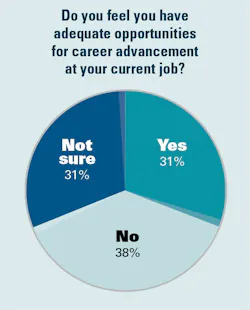
Medical laboratory professionals reported greater uncertainty around career advancement compared with last year. Only 31% of respondents believe they have adequate opportunities, down from 41%. The “not sure” response nearly doubled, to 31% from 17%. Interestingly, those selecting “no” also declined, at 38 in 2026%, down from 43% in 2025.
Perceptions of education and training improved considerably. The combined satisfied responses – those who reported feeling “very satisfied” or “somewhat satisfied” – increased from 71% to 81%, while combined dissatisfaction responses – “somewhat dissatisfied” or “very dissatisfied” – fell from 29% to 19%.
Justice underscored why an investment in education and training must continue throughout a professional’s career: “While I am grateful for my educational background and continue toward my master’s degree, I wish there had been more emphasis on the fact that laboratory science is evolving every day. Some of the knowledge we know now may change to the point of irrelevance as science continues to progress. “Continuing education and the desire for constant improvement are going to be leading factors of relevance as this career field continues to evolve.”
What laboratory professionals have to say about career advancement
MLO asked medical laboratory professionals who took part in the survey to elaborate on opportunities for career advancement at their current jobs. In reviewing the “write in” responses, it appears that career advancement remains a complicated issue.
Limited career ladders are a roadblock to advancement. Those in larger laboratories described a ladder consisting of lead, supervisor, manager, and director positions. In smaller laboratories, some reported that no additional level exists above their current role. Others said advancement depends on waiting for a manager to leave or retire, relocating, or pursuing a position outside the laboratory in areas such as administration, quality, information systems, sales, or corporate operations.
Several respondents also questioned whether moving into management would provide sufficient compensation for the additional workload and stress. “There is opportunity to take on supervisory roles, but I don’t believe the salary is worth the amount of responsibilities,” wrote one lab professional. Another wrote that their job scope had “tripled with regional lab responsibilities” without a formal promotion.
Among those who commented on a positive experience with their career advancement, some cited strong internal promotion practices, clinical career ladders, mentoring, leadership-development programs, tuition support, and opportunities to move across departments. Several had advanced from bench positions into supervisory, managerial, or director roles.
At the same time, not every laboratory professional wants to enter management. Some respondents were satisfied in technical roles, had intentionally stepped away from leadership, were approaching retirement, or prioritized family and work-life balance. As one respondent wrote, “I work part time and my first focus is on my family, but if I chose to return to full time and pursue a leadership position, there are opportunities.”
What laboratory professionals have to say about lab education and training programs
While overall satisfaction with laboratory education and training improved in 2026, the comments from dissatisfied respondents revealed significant gaps. Some reported that their employers provide no laboratory-specific education beyond initial on-the-job training, mandatory safety instruction, or competency activities required for regulatory compliance.
Even when educational opportunities are available, laboratory professionals may not have the time or staffing coverage needed to participate. Respondents described attempting to complete webinars while managing heavy workloads, attending programs after their scheduled shifts, or pursuing education on their own time. Requests to attend off-site seminars and conferences were frequently denied because of staffing shortages or limited budgets. As one respondent explained, “The University offers staff training opportunities, but I cannot take time away from the lab to attend.”
Several respondents also perceived an imbalance between the educational support available to laboratory professionals and nurses. They said nursing staff had greater access to tuition assistance, advanced-degree programs, research opportunities, and institutionally supported professional development. One respondent described the challenge in this way, “Most of the educational opportunities are given to nurses to obtain professional degrees such as masters and doctorate degrees.”
The absence of dedicated laboratory educators was another recurring concern. Respondents said training is often assigned to managers, supervisors, or bench staff already responsible for daily operations. This can result in inconsistent orientation, unclear guidelines, and employees being trained by multiple people.
“I believe this is something that should be a separate job from the day-to-day operations,” said one respondent. “I feel that if a company were to put in the extra work for just one or two individuals for such a program, that the turnover rate would decrease and morale would increase significantly.”
Continuing education and the desire for constant improvement are going to be leading factors of relevance as this career field continues to evolve.
Workforce status, challenges, and opportunities
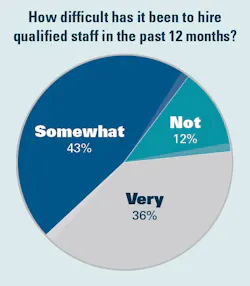
Workforce pressures remain persistent and may have intensified, with 79% of survey respondents reporting difficulty hiring qualified staff in the past 12 months as “very difficult” or “somewhat difficult” (up from 75% in 2025). Reported high or moderate staff turnover during the past 12 months also increased, from 73% to 76%.
Robinson described retention as both a workforce and quality strategy: “It is far more cost-effective to prevent errors with quality staff and retain competent staff than chronic constant turnover with rehire retrain.”
When asked about how the current shortage of medical personnel impacts their labs’ operational efficiency, those reporting a “large impact” jumped from 16% in 2025 to 20% in 2026, while “moderate impact” increased to 43% from 41%. Conversely, reported “low impact” dropped to 30% from 33% and “no impact” to 7% from 9%.
Most laboratory professionals reported that the current shortage of medical personnel did not cause their labs to outsource more tests during last year (71% down from 77%). Additionally, 6% of respondents reported that they have reviewed test and utilization costs and reimbursement levels, 4% reorganized and evaluated supply usage and storage, and 1% increased testing.
Automation activity declined despite ongoing workforce challenges. Only 30% reported their laboratories automating or further automating new procedures last year, down from 39%.
Justice commented on the impacts of increased automation in the medical laboratory environment, stating:
“With continuous advancements in automation in the laboratory, we can offer a greater test menu selection to our patients. For hospitals and clinics, this can help reduce send out testing to result in faster turnaround times. However, this evolution adds more tests, analyzers, and sample volume to current staff numbers, which adds the responsibility of more maintenance, monitoring, and troubleshooting to medical laboratory scientists.”
Looking ahead: Career advocacy and advancement
MLO asked Justice and Robinson whether healthcare leaders, other clinicians, and patients adequately understand the expertise medical laboratory professionals contribute to diagnosis and treatment – and what would help increase that recognition?
“I think the best way to help others understand our contributions to the medical care process is to advocate for ourselves and our profession,” said Justice. “I don’t think people understand the full scope of our knowledge and expertise, but they never will if we continue to allow ourselves to be underrepresented.”
“Laboratory advocacy is each and every one of us individually and together,” said Robinson. “From heath career fairs showcasing elementary to college students along with summer immersion programs to professional societies to lobbying legislators and negotiating at workplace to social media platforms for media attention/public awareness/industry respect/legislative support.”
“We need strong endorsement at the colleges and universities for NAACLS educational curriculum programs and at facilities for increased availability of clinical internships,” she continued. “We need the healthcare community to corroborate to attract, recruit and retain qualified board-certified medical laboratory professionals for quality standards of laboratory testing – patient care deserves no less.”
The survey found that only 31% of respondents believe they have adequate opportunities for career advancement. What can laboratories do to create better career paths for laboratory professionals?
Laboratories need to create visible and intentional career pathways that allow professionals to advance without feeling that their only options are to become a supervisor or leave the laboratory altogether. That could include structured career ladders such as MLS I, II, III, lead, specialist, technical supervisor, manager, and director, with clearly defined competencies and compensation at each level.
We also need to recognize that advancement does not always mean management. Laboratories can develop technical, quality, education, informatics, compliance, and project-management tracks for individuals who want to grow while remaining closer to the technical side of the profession. Formal mentorship, leadership development, succession planning, and support for certifications and continuing education are also important. Most importantly, employees should be able to see what their next opportunity is and understand what they need to do to get there.
Salaries are rising, but confidence in career advancement is declining. Why might those trends be happening at the same time?
I think these trends reflect two different workforce issues. Higher salaries do not necessarily translate into greater career mobility. Laboratories have had to increase compensation to recruit and retain staff in a competitive market, particularly in response to workforce shortages. An important consideration is when these increases are correcting compensation at the current level rather than creating additional levels of advancement.
There is also a potential retention issue when external movement produces greater advancement than internal movement. If professionals perceive that they have to change laboratories or organizations to receive a meaningful promotion or salary increase, their confidence in having a long-term career path within their current organization will naturally decline.
What is most important for making a career in the clinical laboratory sustainable over the long term?
For me, sustainability comes down to compensation, professional growth, recognition, and working conditions. Laboratory professionals need to be compensated appropriately for their education, certification, expertise, and responsibility, but compensation alone will not sustain the workforce.
We also have to create environments where people can envision themselves staying in the profession for 10, 20, or 30 years. That means reasonable staffing and workloads, opportunities for advancement, strong leadership, mentorship, continuing education, and recognition of the laboratory’s contribution to patient care.
I also think we need to invest more in the next generation of laboratory leaders. We often promote excellent technical professionals into leadership roles without providing formal preparation in areas such as finance, personnel management, quality, communication, and change management. Creating sustainable laboratory careers means developing people throughout their careers. All levels of development should be considered, from entry-level professionals through technical experts, supervisors, managers, and directors. We need to be proactive rather than waiting until a leadership position becomes vacant to think about development.
-Brittany Teeter, Ph.D., M.S CLS, MLS (ASCP)cm, Laboratory Director, Retama Community Hospital
What can laboratories do to create better career paths for laboratory professionals?
Laboratories need to create career pathways that extend beyond the traditional progression from bench technologist to supervisor or manager. Career development should also include lateral movement into roles such as QAPI director, grants manager, informatics or quality leadership, and even chief scientific officer, recognizing that laboratory professionals bring analytical, regulatory, operational, and scientific expertise that can add value across the healthcare organization.
Why are salaries rising while confidence in career advancement is declining?
Rising salaries may reflect workforce shortages and competition for qualified laboratory professionals, but the profession itself has progressed more slowly in developing clearly defined advanced career pathways. Compared with other healthcare professions that have long-established terminal practice degrees and strong professional structures, such as the PharmD, DNP, and DPT. The Doctor of Clinical Laboratory Science is still relatively new, and laboratory professionals continue to face fewer widely recognized pathways for advanced clinical and organizational leadership.
What is most important for making a clinical laboratory career sustainable over the long term?
Long-term sustainability requires more than competitive compensation; laboratory professionals need meaningful career development, recognition, manageable workloads, and opportunities to expand their expertise. When laboratorians can see a clear path for professional growth and understand how their work directly contributes to patient care, quality, and clinical decision-making, they are more likely to remain engaged in the profession.
-Cecil James M. Buguis, DHSc, MSHS, MSPGx, MBA, MLS, DLM, Laboratory Director, Winkler County Hospital District; Interim Lab Manager, Iraan General Hospital; Technical Consultant, Ward Memorial Hospital; CEO/Owner, DxRx Expert Solutions LLC
About the Author
 Kara Nadeau
Kara Nadeau
has 20+ years of experience as a healthcare/medical/technology writer, having served medical device and pharmaceutical manufacturers, healthcare facilities, software and service providers, non-profit organizations and industry associations.