Quality management essentials: CLSI standards applied to POCT handheld and traditional blood gas systems
Key Highlights
- Use CLSI standardized equations to independently validate blood gas analyzer calculations after software changes or system upgrades.
- Develop spreadsheets that compare device-reported values with independently calculated reference values for quality assurance.
- Record and document all validation steps to ensure regulatory compliance and facilitate troubleshooting.
- Verify the equations used by the manufacturer against CLSI standards and update validation protocols accordingly.
- Incorporate temperature correction and gas exchange index calculations into validation processes for comprehensive system assessment.

Software/firmware for both new systems and changes/upgrades on existing systems can go well beyond simple functionality checks, especially in current blood gas testing, which may include calculations of reported values from measured values. Blood gas analyzers have always calculated certain quantities, for example bicarbonate, but now also calculate gas exchange indices anion gap and other quantities. Fortunately, the Clinical and Laboratory Standards Institute (CLSI) has standardized many of these calculations, and most manufacturers follow those standards. We suggest the CLSI equations be independently applied to evaluation of blood gas systems both when incorporating a new device and when any software changes/upgrades are performed. We show here one or two examples and list the quantities that have been standardized in this form by CLSI so that each laboratory may identify the ones pertinent to their institution’s measuring systems.
Software changes require more than a function check
Software upgrades are intended either to improve operational performance or fix obvious or occult system inadequacies. However, a consequence of complex software is the potential for unanticipated or unintended changes that affect other parts of the system software. Anyone who uses a cell phone or computer has experienced an automatic update and knows that while it is a great idea, it can also be fraught with unexpected and unrelated performance changes.
Certainly, the laboratory must rely on the manufacturer's integrity and the service technician's competence, as well as a personal check of operational functionality. However, before a system is returned to full service, an excellent quality management protocol requires an independent evaluation of the system’s operational characteristics. This has become even more important as various handheld devices are used by caregivers and support staff rather than medical technologists or equivalently trained professionals.
Nowhere is this more important than for critical care testing, such as blood gas and electrolyte systems. Fortunately, for blood gases, there are some great tools for validating specific aspects of software performance — the multiple calculated quantities that caregivers rely on when diagnosing and treating critically ill patients. Many of these have been standardized in the approved CLSI standards C12A and C25A. When CLSI decided to streamline its system of documents, these two approved-level documents were among several that served as the basis of the current C46A et seq. Unfortunately, this streamlining and consolidation omitted explanatory information and some of the very equations that had been adopted and are currently used by manufacturers but may not be familiar to many laboratorians.These calculated quantities can be critical in evaluating a critical patient’s rapidly changing condition.
Using CLSI equations to validate software
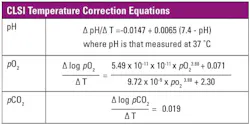
CLSI standards have codified these calculations, which are derived from the measured values using well-established relationships and specific, accepted constants/factors, rather than approximations. These include, for example, the base excess of blood -BE(B), and of extracellular fluid-BE(EC), as well as bicarbonate- cHCO3(B) plus total carbon dioxide-ctCO2. In addition, for laboratories reporting temperature-corrected values for pH, pO2, and pCO2, there are specific adjusting algorithms when a patient’s temperature is other than the nominal 37° C. These CLSI standard equations, when applied independently to measured values from the analyzer dataset, can serve as avatars for the reliability of software change.
Both new systems and systems receiving upgrades or services involving software should be subject to this testing. As with anything involving regulatory issues, a record of the independently calculated values, as well as the values obtained from the device itself, is essential. A useful format for both the calculation and the record keeping is a simple spreadsheet. Examples are shown in Table 1 and Table 2. (Table 1 is the input of measured data; Table 2 is the calculation.)
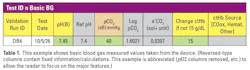
First, note that in the first row of Table 1, there is a label for each measured value reported and as measured by the device (yellow heading), as well as standard constants (From the CLSI documents) and required internal calculations (gray heading) both of which were authenticated to the CLSI writers by the original authors (Ole Siggaard-Anderson, MD, PhD and John Severinghaus, MD, PhD) as witnessed by this author.
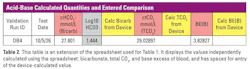
Table 2 shows the appropriate values, independently calculated from the entered measured values (pink heading), and a corresponding place to manually enter each value calculated by the device itself (yellow heading). Together, a clear record of the validation is satisfactory for internal quality management, as well as a record that should satisfy any regulatory body.
As with anything involving regulatory issues, a record of the independently calculated values, as well as the values obtained from the device itself, is essential.
Building a software validation protocol
A recommended protocol for the performance of software checks should include the initial set-up of the spreadsheet as follows:
- First, contact the manufacturer to determine what equations are in use (i.e., verify the operator's manual is correct).
- Next, verify that the output calculated values’ equations are either identical to the CLSI equations or, if not, state what the equations for your system are.
- Then develop the appropriate spreadsheet with the equations. (If not CLSI standard equations, get assistance from the manufacturer!)
- Note the columns on the spreadsheet for the calculated value from the reference equations and a separate column for manual entry of the values obtained from the analyzer. Other columns (gray, reverse type) are used to show the constants used or an intermediate calculation result, to track errors or changes more easily.
- Decide on a frequency and/or situation requiring revalidation. (This may be dependent on the type of device, in-lab, mobile (cart), or handheld).
It may be impossible to check all the items that can be affected when the software changes are implemented. However, using this approach does give you certainty regarding these specific values reported and that they are based on established calculations, clinical requirements, and known physical constants, as certified by CLSI documents.
In the example shown in Table 3, recall that basic blood gas instruments have been reporting measured values (pH, pO2 or pCO2) along with some calculated values since the beginning of routine blood gas measurements. Evaluating these (base excess and bicarbonate/total carbon dioxide), would constitute a great start in improving QA processes.
Beyond the basic blood gas calculations
Later, introduction of temperature-corrected values and gas exchange indices should advance this process for those reporting those values. While some of these temperature correction calculations are simple, some algebraic manipulation is necessary to put it into a useful form for a spreadsheet. For each quantity (i.e., pH, pO2, and pCO2), the equation would use the measured value from the analyzer minus the patient temperature-corrected value (e.g., for ΔpHà (pHm-pHp.). The Δ T would be the measuring temperature (37o) minus the patient temperature: ΔT à(Tm-Tp).
The more complex form of the pO2 temperature correction is a consequence of the influence of the oxyhemoglobin dissociation curve (ODC). Most manufacturers use this form, but at least one uses a still more complex form that first measures more characteristics of the ODC. The form shown here was asserted by personal communication from both John Severinghaus and Ole Sigaard- Anderson to be more than adequate for clinical use. As a practical note, the form shown here is more easily treated in a spreadsheet by separately calculating the numerator and denominator, then applying them to the general form of the equation.
Putting standardized equations to work
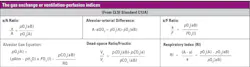
The gas exchange or ventilation-perfusion indices (Table 4) are taken from the definition of each of those terms. For laboratorians unfamiliar with those terms, some of the more cryptic abbreviations in use can confuse. Consequently, they are all listed on the table. Operationally, these can present a challenge since some input values must be obtained separately and/or assumptions made. However, if your system reports these, you need to be aware of their proper form as well as limitations.
These equations/algorithms/indices are shown in Table 4. Each of these calculations is simple but requires information obtainable typically only at the bedside in addition to values measured by the device. These were curated by the C12A committee’s experts and advisors and validated by practicing clinicians. They are recorded in C12A as standard forms of equations based on their definition.
Unfortunately, since the consolidation of multiple CLSI standards for blood gas and related quantities into one document (C46A), many of these agreed-upon standard equations and corresponding information, although still valid, are relegated to dusty electronic archives. This makes it difficult to set up the most complete spreadsheet to conduct the process just recommended for all calculated quantities. However, the certainty of evaluating the calculations done and reported most frequently should assure you that your system software is working well.
Conclusion
Some of these equations were established nearly a century ago and include constants and factors that may have been finalized decades ago; they are still useful in today's quality management systems. While cloud-sourced data may be useful in many situations, the consensus information contained in these equations is invaluable for the assurance of consistency of results reported by blood gas and related systems. Performing independent analysis of calculations from current handheld or lab-based blood gas analyzers ensures that this part of the software matches the clinical results, but also that there is a record of the comparisons available for management, clinicians, and regulators.
REFERENCES
- Ehrmeyer S, Burnett RW, Chatburn RL, et al. Definitions of quantities and conventions related to blood pH and gas analysis-Second Edition. Nat Comm Clin Lab Standards C12-A. Published online 1994.
- Ehrmeyer S, Burnett RW, Chatburn RL, et al. Performance characteristics for devices measuring PO2 and PCO2 in blood samples. Nat Comm Clin Lab Standards. Published online 1992. NOTE: Certified American National Standard- ANSI.
- Ehrmeyer S, Burnett RW, Chatburn RL, et al. Fractional oxyhemoglobin, oxygen content and saturation, and related quantities in blood: Terminology, measurement and reporting; Approved Guideline. NCCLS C25-A. Published online 1997.
- Moran RF, Bergkuist C, Graham GA, Misiano DR, O’connell K, Sena SF. Considerations in the simultaneous measurement of blood gases, electrolytes, and related analytes in whole blood-Proposed Guideline. Nat Comm Clin Lab Standards C32-P. Published online 1993.
- Burnett R, Ehrmeyer SS, Moran RF, vanKessel A. Blood gas and pH analysis and related measurements. NCCLS C46-A. Published online 2001. (Consolidation of C12, 21, 25, 32 and an unpublished C33 on quality assurance.)
About the Author
 Robert F Moran, PhD, FCCM FACB
Robert F Moran, PhD, FCCM FACB
is the Principal Scientist at mviSciences, a consulting and educational services organization and President of AccuTest Proficiency Testing Services. Dr. Moran served multiple terms on the NCCLS (Now CLSI) Board of Directors and was an active participant or chairholder in several of their blood gas and electrolyte standards-writing teams. Also active in clinical chemistry internationally, he is an appointed Fellow of the International Union of Pure and Applied Chemistry (FIUPAC). He is a retired professor of chemistry and physics from Wentworth Institute of Technology but remains active in consulting work and writing.