How lab leaders successfully turn executive interest into investment
Key Highlights
- Lab leaders are shifting their approach from operational focus to strategic positioning by aligning initiatives with organizational goals like patient outcomes and financial performance.
- Effective communication involves translating lab metrics into business outcomes, demonstrating measurable results, and highlighting the risks of inaction to motivate leadership support.
- Building influence with clinical partners and framing proposals around organizational priorities can enhance the lab’s visibility and support strategic investments.
- Data storytelling that combines clinical, operational, and financial impacts helps make the laboratory’s value clear to healthcare executives.
- Addressing staffing shortages and aging infrastructure requires framing requests in terms of patient care, throughput, and organizational growth to secure necessary resources.

Laboratory leaders have worked incredibly hard to change a stubborn perception that the clinical laboratory is primarily a cost center. New research suggests the effort is paying off.1 As healthcare leaders pursue financial sustainability and ways to improve patient satisfaction, care, and quality outcomes, their attention is focused on clinical laboratory services.
A national survey conducted by YouGov of 155 U.S. healthcare executives whose organizations perform laboratory testing on site found strong agreement that they believe the lab contributes to patient care, operational efficiency, and organizational performance. More than half characterized their laboratory as an important clinical enabler rather than simply an operational function; some described their lab as an underutilized opportunity.
Yet recognition does not always translate into investment. Many laboratory leaders still struggle to secure capital funding, staffing support, technology upgrades, or a stronger voice in strategic decisions. We’ve observed the difference often comes down to positioning: successful leaders present organizational solutions rather than laboratory needs.
Healthcare executives’ perceptions of lab challenges
Laboratory professionals know firsthand that staffing constraints and aging technology can affect turnaround times, productivity, testing capacity, and overall efficiency. Healthcare executives may only see part of that picture: 65% of respondents acknowledge lab staff shortages have affected their organization, and one-third of that group say those shortages are not prioritized at the same level as shortages affecting other clinical departments.
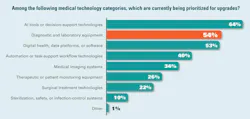
By comparison, 84% of respondents recognize the threat aging laboratory equipment poses to their institution and its mission. They even rank diagnostic and laboratory equipment among their top upgrade priorities, second only to AI-enabled tools or decision-support technologies (see Figure 1).
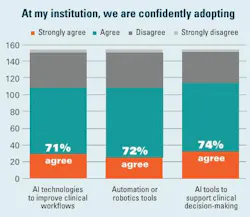
While executives broadly support lab modernization, the questions with the strongest disagreement pertained to whether their organizations are adopting technologies such as automation and AI, which are tools designed to reduce manual workloads, automate workflows, and alleviate pressure on staffing resources (see Figure 2). Helping healthcare executives understand the value of these new technologies is needed to fully appreciate the benefit in laboratory productivity — which impacts patient care.
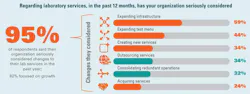
The good news for lab leaders is that 95% of respondents say their organization has considered changes to their laboratory services in the past year, with 82% focused on expanding services (see Figure 3).
Turning C-suite insights into strategic impact
When investments stall, the respondents say the leading reason is because the costs versus the benefits are still unclear. To drive forward implementation, laboratory leaders must align their business cases with executive priorities. Healthcare executives say they are focused on sustaining financial performance, improving patient satisfaction, reducing clinical errors, and enhancing quality outcomes. When evaluating technology investments, they place particular emphasis on improved operational performance and stronger patient care outcomes.
What’s worked for lab leaders
This organization-centric approach was reinforced during a recent advisory board meeting held by Siemens Healthineers, where laboratory leaders described strategies that closely mirror the survey findings. Leaders who successfully convince their C-suites to invest position the lab as a strategic contributor to organizational goals, not simply a diagnostic service. They increase visibility, influence decisions, and secure support from executive leadership teams by translating laboratory performance into business outcomes.
Rather than leading with test volumes, instrumentation needs, or operational challenges, they frame discussions around patient throughput, length of stay, staffing efficiency, quality outcomes, revenue opportunities, financial stewardship, and growth. A staffing request becomes a conversation about throughput and patient care. A technology proposal becomes a case for measurable operational improvement, financial value, and quality outcomes. A modernization initiative becomes a health system priority rather than a departmental need.
Lab leaders emphasized that the laboratory gains more visibility when they proactively connect their initiatives to the organization's strategic priorities. Whether requesting additional staff, capital investments, new technology, or expanded laboratory space, successful proposals were tied directly to enterprise goals and accompanied by clear measures of success.
Data is critical to building credibility, but data alone rarely drives action. Rather than simply reporting performance metrics, they shared examples of establishing accountability measures, tracking outcomes over time, and regularly demonstrating how laboratory initiatives delivered measurable organizational value. The strongest presentations created a story — combining clinical, financial, operational, and patient impact into a clear narrative that explains why the issue matters to the organization, its patient care objectives, or its long-term growth strategy.
Pair ROI with the risk of inaction
Perhaps the strongest takeaway is the value of greater transparency and of making the risk of inaction more visible to leadership. While some laboratory leaders may hesitate to openly discuss their challenges, others who have taken the chance say their executive teams have responded more strongly to the cost of inaction than to ROI calculations alone. Delayed patient care, lost revenue opportunities, stalled growth initiatives, staffing shortages, aging infrastructure, and limits on service expansion all help clarify what is at stake.
The path forward to convert executive interest into investment is to speak the language of organizational priorities. These actions can help:
- Translate laboratory metrics into business outcomes. Connect performance to patient care, operational efficiency, financial stewardship, growth, and quality.
- Align requests with organizational priorities. Show how each proposal supports objectives already important to executive leadership.
- Use data to build credibility. Track outcomes and demonstrate measurable results over time.
- Tell a broader story. Combine clinical, financial, operational, and patient impact so leaders understand the laboratory’s role in organizational success.
- Communicate the cost of inaction. Highlight risks, missed opportunities, and patient impact alongside ROI.
For lab leaders who are still working to gain a stronger voice with their executive teams, the first step may be to build influence through trusted clinical partners. Clinicians can help make the laboratory’s impact visible by connecting test performance, turnaround time, access, and diagnostic confidence to the care decisions healthcare executives already prioritize. Pairing clinical perspective with clear business outcomes makes the lab’s value even harder to overlook.
REFERENCES
- Turning C-suite insights into strategic impact. Siemens-healthineers.com. July 14, 2026. Accessed September 8, 2026. https://www.siemens-healthineers.com/en-us/executive-survey-lab-services.
About the Author
 Michele Zwickl
 Michele Zwickl
is the head of Laboratory Solutions, Diagnostics for Siemens Healthineers North America. In this capacity, she oversees commercial operations in the largest geographical market for the business. Siemens Healthineers manufactures the Atellica portfolio of core laboratory solutions.
 Jody Dalberg, MLS (ASCP)CM
Jody Dalberg, MLS (ASCP)CM
serves as the Laboratory Director at Advocate Good Shepherd Hospital, where he provides leadership for laboratory operations, quality, compliance, teammate engagement, and service excellence in support of safe and reliable patient care. In addition to his site-based leadership role, Jody is an active leader within ACL – Advocate Clinical Laboratory, helping advance enterprise laboratory standards, operational consistency, process improvement, and collaboration across teams.