Essential functions and technical standards in U.S. phlebotomy programs
To take the test online go HERE. For more information, visit the Continuing Education tab.
LEARNING OBJECTIVES
1. List and describe the five core domains of essential functions for phlebotomy students with examples from clinical practice.
2. Discuss key methodological features and trustworthiness strategies of the study from the article.
3. Explain how essential functions relate to patient safety, clinical competency, and accommodation considerations.
4. Analyze implications of variability in program technical standards for admissions, clinical readiness, and inclusive educational practices.
Phlebotomy education programs serve as critical entry points into the clinical laboratory workforce, preparing phlebotomy students to perform venipuncture, capillary collection, specimen handling and processing, and patient interaction across diverse healthcare settings. To safeguard patient safety and ensure competence, programs require phlebotomy students to meet essential functions and technical standards, outlining abilities necessary for successful participation in coursework and clinical experiences.9 However, limited research has systematically examined the content, structure, and implications across programs.
Although essential functions are routinely published by educational institutions, these documents are rarely examined as curricular artifacts reflecting professional values, legal interpretations, and access considerations. Publicly available essential functions and technical standards from phlebotomy programs in the United States were analyzed to identify common domains, professional expectations, and implications for student access, accommodations, and readiness for clinical practice. Five major thematic domains emerged: (1) physical and motor abilities, (2) sensory and observational skills, (3) cognitive and intellectual abilities, (4) communication and interpersonal competence, and (5) behavioral professionalism and safety. Across documents, language emphasized patient safety, infection control, and professional conduct, while variability existed regarding reasonable accommodations and disability inclusion. With increasing emphasis on diversity, equity, inclusion, and compliance with the Americans with Disabilities Act (ADA), analyzing how educational programs articulate functional requirements is both timely and necessary.12
Methods
A qualitative document analysis methodology was employed to systematically examine essential functions and technical standards from publicly available websites. Document analysis is well suited to exploring policy language, professional norms, and implicit assumptions embedded in formal educational documents.4 Documents were drawn from community colleges, technical colleges, and private training institutions across multiple states that were:
- NAACLS-accredited or state-approved
- Offered as certificates or technical diplomas
- Explicitly labeled as “Essential Functions,” “Technical Standards,” or equivalent
The programs included in this analysis were geographically diverse, representing the Southeast, Mid-Atlantic, Midwest, and Northeast regions of the United States, with a notable concentration of community college-based programs in North Carolina. A total of nine institutions met the inclusion criteria and were analyzed in this study. Data collection occurred within a defined timeframe from June 2025 through May 2026 to ensure consistency and comparability of retrieved materials. Documents were imported into qualitative analysis software and analyzed using inductive thematic analysis. Initial open coding identified discrete functional requirements. Codes were then grouped into higher‑order categories, which were refined into thematic domains consistent across programs. Analysis was iterative, with repeated comparison to ensure internal consistency and analytic rigor. Credibility was supported through peer debriefing with allied health educators. Dependability was enhanced via an audit trail documenting coding decisions. Reflexivity was maintained by acknowledging the researcher’s role as an allied health educator.
Results
Analysis of publicly available essential functions and technical standards from U.S. phlebotomy programs revealed substantial consistency across institutions in articulating expectations necessary for student participation in didactic and clinical education. Documents reviewed were obtained from accredited and state‑approved phlebotomy programs and supported by national accrediting and professional guidance.1,9 The domains, while presented individually for clarity, reflect integrated competencies that operate simultaneously in clinical practice, where technical, cognitive, and interpersonal skills are inherently interdependent.
Physical and motor abilities
All reviewed programs required phlebotomy students to demonstrate sufficient physical capability and fine motor dexterity to safely perform phlebotomy‑related tasks. Institutional documents consistently cited manual dexterity for venipuncture and capillary collection, specimen labeling, and equipment handling as essential functions.2,11 Additional expectations included the ability to stand for extended periods, bend and reach safely, and lift light supplies necessary for clinical procedures. These requirements were closely aligned with national procedural standards for venous blood collection, emphasizing safe needle handling, patient positioning, and infection control.5
Sensory and observational skills
Sensory requirements were a prominent component of essential functions across all reviewed documents. Programs emphasized adequate visual acuity, with or without corrective devices, to identify veins, select appropriate collection tubes, verify patient identifiers, and assess specimen integrity.6,7,13 Tactile sensation was frequently identified as necessary for vein palpation and assessment of vascular accessibility, while auditory ability supported effective patient communication, reception of clinical instructions, and recognition of equipment alarms or environmental cues. These expectations reflect the observational demands inherent in safe phlebotomy practice and error prevention.9
Cognitive and intellectual abilities
Cognitive and intellectual abilities constituted a core domain within all essential functions documents reviewed. Programs required phlebotomy students to interpret test orders, follow multi‑step procedures accurately, and apply critical thinking in specimen collection, handling, and troubleshooting.9,10 Essential functions frequently referred to the ability to recognize errors, prioritize tasks, and respond appropriately to unexpected clinical situations.3 The emphasis on cognitive processing was closely associated with patient safety objectives and workforce readiness, aligning educational expectations with professional competency standards outlined by the ASCP.1
Communication and interpersonal competence
Nearly all reviewed documents underscored the importance of effective communication and interpersonal skills as essential for phlebotomy students. Programs required clear verbal and nonverbal communication with patients, healthcare staff, and instructors, as well as the ability to obtain patient cooperation and explain procedures in a professional and culturally sensitive manner.10,13 Interpersonal competence was frequently framed within a patient‑centered care model, emphasizing respect, empathy, and professionalism in diverse clinical environments.8 These expectations reflect the interpersonal nature of phlebotomy practice and align with national workforce competency guidance.1
Behavioral professionalism and safety
Behavioral professionalism and adherence to safety standards were universally emphasized across all reviewed documents. Programs highlighted emotional stability, ethical conduct, accountability, and compliance with infection control and safety policies as essential functions for student participation in clinical education.2,9 Institutions explicitly linked these behavioral expectations to workplace readiness and employer requirements, indicating that essential functions extend beyond technical skill to encompass professional identity formation.14 References to ethical behavior, reliability, and stress management were consistent with federal guidance regarding professional standards in healthcare education.12
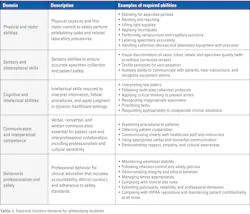
The five major domains emerged consistently across the analyzed documents. Collectively, these functions encompass accurate patient identification and appropriate specimen collection methods (including correct devices and containers, processing, transport, and storage). Although the domains are presented discretely for readability and policy development, overlap among them is intentional and reflects real‑world laboratory practice, where competencies are integrated rather than isolated (e.g., communication competencies often manifest through professional behaviors such as confidentiality, accountability, and teamwork). The analysis of essential functions documents revealed five competency domains required for successful participation in phlebotomy education and clinical practice. Together, they represent the functional expectations necessary to meet accreditation requirements and to ensure patient safety. A summary of these essential function domains and representative examples is presented in Table 1.
Discussion
The findings of this qualitative document analysis demonstrate that essential functions and technical standards used across U.S. phlebotomy programs are highly consistent and closely aligned with the cognitive, psychomotor, and behavioral demands of contemporary clinical practice. Rather than functioning as discrete requirements, the identified competency domains reflect integrated expectations necessary for safe, effective entry-level performance. The consistency observed across institutions supports the continued use of essential functions as a defensible and essential component of phlebotomy education.
The inclusion of physical and motor abilities as essential functions is strongly supported by the technical demands inherent to phlebotomy procedures. Venipuncture and capillary collection require precise hand–eye coordination, sustained manual dexterity, and the safe manipulation of collection equipment. Programs consistently emphasized the ability to perform repetitive fine motor tasks, maintain positioning for extended periods, and handle supplies with accuracy, reflecting procedural expectations established in national practice standards (CLSI, 2023). Importantly, these requirements are appropriately framed as functional outcomes rather than fixed physical characteristics. This distinction reinforces their role in ensuring patient safety while maintaining alignment with disability accommodation principles, allowing phlebotomy students to meet expectations with reasonable supports when appropriate.
Sensory and observational abilities emerged as foundational across all reviewed documents, underscoring their essential role in maintaining specimen integrity and patient safety. Visual acuity, tactile perception, and auditory processing are integral to critical tasks such as vein identification, patient verification, equipment monitoring, and contextual awareness in clinical environments. The explicit inclusion of these functions reflects the well-established connection between observational accuracy and error prevention in laboratory medicine. Notably, many programs acknowledged that sensory requirements may be fulfilled with corrective devices, suggesting an emerging recognition of inclusive practice while preserving performance standards. This approach supports accessibility without compromising clinical competence.
Cognitive and intellectual abilities were consistently positioned as central to phlebotomy practice, reinforcing that technical skill alone is insufficient for safe patient care. The ability to interpret test orders, follow multi-step protocols, recognize errors, and respond to unexpected situations reflects the complexity of clinical decision-making in even entry-level roles. These expectations align with national competency frameworks and highlight the critical role of judgment, adaptability, and procedural understanding in minimizing preanalytical errors. By embedding cognitive expectations within essential functions, programs ensure that phlebotomy students are prepared not only to perform procedures but also to engage in safe and informed clinical reasoning.
Communication and interpersonal competence were emphasized across nearly all documents, reflecting the patient-centered nature of phlebotomy practice. Effective communication is essential for explaining procedures, gaining patient cooperation, and collaborating with healthcare team members. These skills are directly linked to patient outcomes, including procedural success and patient satisfaction. The inclusion of cultural sensitivity and professionalism further reflects evolving expectations in healthcare delivery, where equitable and respectful patient interactions are considered fundamental competencies. Framing communication as an essential function reinforces its role as a clinical requirement rather than a secondary or “soft” skill.
Behavioral professionalism and adherence to safety standards were the most uniformly articulated expectations across programs. Emotional stability, ethical conduct, accountability, and compliance with infection control protocols were consistently identified as essential to student participation and clinical readiness. These expectations reflect not only institutional policies but also broader regulatory and workforce demands. By explicitly including professionalism within essential functions, programs emphasize that technical proficiency must be accompanied by ethical responsibility and professional behavior. This integration supports the development of professional identity and reinforces the expectations of healthcare employers.
Although the core competency domains were highly consistent across institutions, variability was observed in how programs addressed reasonable accommodations and disability inclusion. Some documents explicitly acknowledged that essential functions could be met with accommodations, while others omitted this language entirely. This inconsistency represents a critical opportunity for improvement. Standardizing the inclusion of ADA-informed language would enhance transparency for prospective phlebotomy students and promote equitable access to phlebotomy education. Clear articulation of how accommodations are considered can reduce ambiguity and ensure alignment with federal guidance while maintaining program integrity.
The findings also highlight the dual role of essential functions and technical standards as both educational tools and regulatory documents. These standards serve to communicate expectations, guide student self-assessment, and support admissions and progression decisions. At the same time, they function as legal and ethical frameworks that institutions must carefully construct to balance inclusivity with patient safety. When framed appropriately, essential functions are not exclusionary but rather define the outcomes necessary for safe clinical practice. Emphasizing functionality, rather than rigid criteria, can support both educational rigor and accessibility.
From a broader perspective, the consistency of domains across diverse institutions suggests an implicit national model of phlebotomy competency, even in the absence of fully standardized language. This convergence reflects strong alignment between educational expectations and professional practice requirements. However, the variability in terminology, structure, and clarity indicates that further standardization may enhance usability and accessibility of these documents. Developing shared language frameworks across programs could improve transparency for phlebotomy students and support more equitable admission practices across institutions.
Together, these findings support the continued use of essential functions and technical standards as critical components of phlebotomy education. The identified domains are clearly justified by patient safety requirements, competency expectations, and workforce readiness outcomes. However, strengthening clarity, standardization, and inclusivity—particularly with respect to accommodation language—would further enhance the effectiveness and equity of these documents. As phlebotomy programs continue to evolve within increasingly diverse educational and clinical environments, ongoing evaluation and refinement of essential functions will remain necessary to ensure alignment with both professional standards and inclusive educational practices.
Conclusions
This qualitative document analysis identified consistent expectations across U.S. phlebotomy programs regarding essential functions and technical standards required for student participation and clinical readiness. Five core domains—physical, sensory, cognitive, communication, and professional behaviors—were consistently represented, reinforcing alignment between educational requirements and workforce expectations. These competency domains collectively reflect the multidimensional skill set required for safe phlebotomy practice and reinforce the integration of technical, cognitive, and professional expectations within clinical education.
The findings highlight the importance of essential functions as both educational and regulatory tools that support patient safety and competency development. However, variability in how programs articulate accommodations suggests a need for more standardized and inclusive language consistent with ADA guidelines.
Strengthening clarity, accessibility, and transparency in essential functions documents can enhance equity in admission practices while maintaining academic and clinical rigor. Future research should explore how these standards are implemented in admissions and clinical evaluation processes, as well as their impact on student diversity and success in phlebotomy education.
References
- Phlebotomy technician competencies and scope of practice. American Society for Clinical Pathology. Published 2022. Accessed July 8, 2026. https://www.ascp.org.
- Phlebotomy technician essential functions and technical standards. Austin Community College. Published 2024. Accessed July 8, 2026. https://drive.google.com/file/d/1Ezjmnx7xttU71hS-ZSzStMmNza7xEgRm/view.
- Phlebotomy technician technical standards. Beaufort County Community College. Accessed July 8, 2026. https://www.beaufortccc.edu/wp-content/uploads/2026/04/Phlebotomy-Technician-Technical-Standards.pdf.
- Bowen GA. Document analysis as a qualitative research method. Qual Res J. 2009;9(2):27-40. doi:10.3316/qrj0902027.
- Collection of Diagnostic Venous Blood Specimens (CLSI GP41). 7th edition.; 2023.
- Essential requirements for the phlebotomy program. Community College of Philadelphia. January 22, 2025. Accessed July 8, 2026. https://www.myccp.online/sites/default/files/documents/MedicalLaboratoryTechnician/phlebotomy-essential-requirements-20250122.pdf.
- Phlebotomy program technical standards. Davidson-Davie Community College. Published 2025. Accessed July 8, 2026. https://www.davidsondavie.edu/wp-content/uploads/2025/09/Phlebotomy-Program-Technical-Standards.pdf .
- Phlebotomy technician technical standards. Mid-State Technical College. Accessed July 8, 2026. https://www.mstc.edu/sites/default/files/2026-05/Phlebotomy-Technician-Grouping-Technical-Standards.pdf.
- Standards for accredited phlebotomy technician programs. National Accrediting Agency for Clinical Laboratory Sciences. Last updated May 2026. Accessed July 8, 2026. https://naacls.org/wp-content/uploads/2024Standards.pdf.
- Phlebotomy career studies certificate program: Essential functions. Northern Virginia Community College. Accessed July 8, 2026. https://www.nvcc.edu/academics/programs/pbt-essential-functions.html.
- Essential functions for phlebotomy students. Tower Health. Accessed July 8, 2026. https://reading.towerhealth.org/app/files/public/71d2f35a-a41b-4e16-88e5-41d8816a7d38/phlebotomist-essential-functions.pdf.
- The Americans with Disabilities Act: Title II technical assistance manual: Covering state and local government programs and services. U.S. Department of Justice, Civil Rights Division. Published 1993. Accessed July 8, 2026. https://archive.ada.gov/taman2.html.
- Phlebotomy program technical standards. Wake Technical Community College. Published 2024. Accessed July 8, 2026. https://www.waketech.edu/sites/default/files/program-page-files/Phlebotomy-technical-standards.pdf.
- Phlebotomy essential functions. Western Technical College. Accessed July 8, 2026. https://www.westerntc.edu/sites/default/files/programs/documents/Phlebotomy_Essential_Functions.pdf.
To take the test online go HERE. For more information, visit the Continuing Education tab.
About the Author
 Lori Bane, PhD, MT(ASCP)
 Lori Bane, PhD, MT(ASCP)
serves as the Program Director for Medical Laboratory Tech and Phlebotomy Programs at Chattahoochee Technical (Chatt Tech) College. She is a seasoned public health professional and laboratory scientist with over 30 years of experience spanning federal government and clinical laboratory practice.