
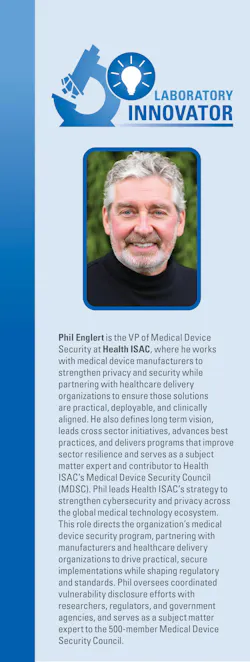
What cybersecurity risks are most unique to laboratory environments compared to other healthcare settings and are labs often overlooked in enterprise security strategies?
Three major risks are as follows:
- Legacy instruments — while core lab instruments such as chemistry, hematology, coagulation and increasingly immunochemistry tend to be newer due to the increasing types of assays they can run, other specialty analyzers supporting non-core functions, such as blood gas, urinalysis, microbiology, flow cytometry, and others may be dated and lack today’s commonly applied security controls.
- Clinical diagnostic analyzers are often supplied through creative funding mechanisms where the operator does not own the devices and have limited say in what controls can be applied, how often they are updated, and if cyber resilience and updating are included in the agreements. These vendor‑managed systems can be a blind spot for healthcare organizations.
- Considering that a small facility laboratory may have 6–8 diagnostic specialties and a large academic or reference lab may support 20 or more specialty departments, the vast array of LIS middleware and interfaces needed to keep data flowing from intake to reporting requires significant work to secure, maintain, and update. The update cycles for disparate components maintained by different parties may not align resulting in development and patching application delays that extend the exposure period of known or even exploited vulnerabilities.
Can you share real‑world examples of how a cyber incident or IT disruption directly affected lab operations, turnaround times, or diagnostic accuracy, and what the downstream impact was on patient care?
A few examples are as follows:
In April 2025, a large national laboratory provider reported that a ransomware group gained access to a laboratory database containing patient information, highlighting the vulnerability of laboratory databases as high‑value targets, which may be overlooked in broader health system security architectures. While interim measures were implemented to allow for the restoration of certain functions, the lab could not estimate the duration or extent of the disruption.
A Netherlands lab was hit with a data breach and ransomware in July 2025 where hackers gained access to 850,000 patient records, demonstrating the scale of impact when labs systems are compromised. Lab services were suspended while an independent investigation into the IT security systems was conducted resulting in delayed diagnostics.
The FDA issued a warning for a genetic sequencing device regarding a vulnerability that could allow intruders to access or alter genomic information intended for clinical diagnosis and could cause the instruments to provide incorrect results or no results at all. The company recently agreed to pay a $9.8M settlement. "Failure to adhere to required cybersecurity standards can result in significant damage,” stated a law enforcement officer.
Where are lab directors most likely unaware of their biggest operational or cybersecurity vulnerabilities today, and how can they better assess risk without needing deep IT expertise?
One blind spot may be the sheer number of interfaces that exist in the connected clinical laboratory environment. Each boundary must be inventoried and the PHI flow mapped as indicated in the proposed changes to the HIPAA security rules. These interfaces include external connections whether for remote servicing, order entry and reporting, or data transfers to public health monitoring agencies.
In addition, artificial intelligence (AI) tools can significantly increase insider‑threat risk by amplifying capability, speed, and opacity in ways traditional controls were not designed to handle. AI excels at summarization, transformation, and pattern extraction making large data sets more attractive and more accessible.
FDA explicitly recognizes cybersecurity as a patient safety and data integrity risk. Diagnostic systems can be technically functioning but clinically untrustworthy.
How should laboratory leaders rethink their approach to cybersecurity, from trying to prevent every incident to ensuring continuity of diagnostics when disruptions inevitably occur?
Increasingly, cybersecurity discussions are focused on resilience to include not just protective measures but how to minimize disruptions and restore clinical operations quickly. The best way to do this is to lean into the equipment operators. They are in the best position to identify glitches and anomalies that may indicate a cyber event. Empower them for the Toyota moment when they can hit the stop button and verify nothing is amiss.
The FDA recognizes cyber weaknesses and vulnerabilities as a quality issue. Anytime someone can cause your equipment to operate in an unexpected manner, to cease operating, or impact data integrity, there is a quality issue in the code, configurations, and controls, which were not designed correctly to block that event. Segment the LIS system architecture in such a way that ransomware affecting HR, finance, or email systems from halting diagnostics. Cyber response is focused on containment, not immediate diagnostic continuity.
If a lab has limited budget and staff, what are the top two or three security or resilience improvements that deliver the most immediate risk reduction?
- Ensure LIS configurations, test dictionaries, and historical results are recoverable without network dependency. UC San Diego’s Center for Healthcare Cybersecurity unveiled Project CRASHCART — a “hospital IT system in a box” built to restore critical digital infrastructure after ransomware strikes: https://cyberhealth.ucsd.edu/media-hub/in-the-news.html. The clinical lab is an ideal application for this or similar technologies as lab results support so many other critical patient care workflows.
- Testing downtime workflows; including manual accessioning, result entry, and verification during department meetings or section huddles enables staff to rehearse the exact steps they’d take under pressure, reducing hesitation and errors during real outages, and identifying process gaps early.
- Cybersecurity tabletop exercises (TTXs) are only effective in healthcare when they are intentionally optimized for the clinical reality of tight schedules, competing priorities, patient care risk, and regulatory pressure. Keep them short, focused, and predictable — scoping one operational stress point at a time. Hold them frequently to turn thought processes into muscle memory, faster decision making, and organizational trust. Center on leadership decisions. Cyber risk is operational risk so surface decisions leaders will face. Resist fixing things and focus on remaining clinical capacity. ‘What care do we continue, modify, or stop right now?’ ‘What do we communicate to whom?’ Key participants should include the lab director and section leaders, nursing leadership, medical director, IT operations, risk management, and IT security as advisors.
Communications-focused TTX should be top of list. Role clarification, authority, and escalation paths are essential for the alignment of operational, clinical, and executive messaging to reduce hesitation and oversharing. Optimized TTXs demonstrate that downtime procedures, incident command structure, and communication channels exist. Capture three to five actionable insights and commit to working them before the TTX. Three to six, 60–90 minute operational rehearsals each year can add real value without disrupting care.
About the Author
 Christina Balsano