Combining strengths and improving care
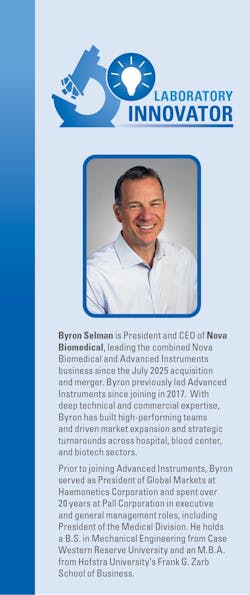
How will the merger of Advanced Instruments and Nova Biomedical enhance the value proposition for clinical hospitals—specifically in terms of improving diagnostic accuracy, operational efficiency, and patient outcomes?
The merger of Advanced Instruments and Nova Biomedical marks a transformative step forward for clinical hospitals worldwide. By uniting two industry leaders under the Nova Biomedical name, we are combining complementary strengths in analytical instrumentation, research, and development, and global customer support. This strategic integration enhances our value to hospitals uniting best-in-class technologies and decades of expertise in laboratory diagnostics, enabling us to deliver more precise, reliable, and reproducible results. The potential to now combine our world class technologies onto singular platforms with expanded functionality will significantly enhance how we serve our customers and patients, empowering clinicians to make faster, more confident decisions, ultimately improving patient care and outcomes.
The merger will also help our customers streamline their workflows and provide integrated solutions that address the evolving needs of modern clinical laboratories. We support our customers with a unified global network that ensures responsive service, comprehensive training, and ensures seamless product integration. We help customers reduce downtime, optimize resource utilization, and support laboratories in delivering timely results—even in the face of staffing challenges or increased demand.
At the heart of this merger is a shared commitment to improving patient outcomes. By expanding our footprint in healthcare settings, we are better positioned to support clinicians across the continuum of care—from diagnosis to treatment monitoring. Our dedication to innovation keeps us at the forefront of life science advancements, delivering new solutions that address healthcare’s most pressing challenges. As one unified brand, we remain dedicated to delivering gold-standard solutions, supporting customer workflows, improving automation, and driving meaningful improvements in healthcare delivery. We are excited about the opportunities this merger creates and remain steadfast in our mission to support hospitals in achieving the highest standards of diagnostic excellence and patient care.
How do you approach post-market support, training, and feedback from customers to improve products over time?
Our commitment to customers extends well beyond the initial installation of our products. We take a proactive, multi-faceted approach to post-market support, training, and continuous improvement. From order placement through implementation, our dedicated service and support teams engage with customers to ensure seamless installation, comprehensive training, and rapid response to any question or challenge. This includes our ‘Hypercare’ program, designed to provide enhanced early-stage support and communication during the critical product implementation period.
Customer feedback is also central to our new product development process. We systematically collect and analyze input through surveys, direct conversations, and ongoing customer engagement. This feedback is reviewed by our internal teams, and it directly informs both incremental enhancements and long-term innovation. Our goal is to foster deep partnerships with clinical laboratories, ensuring that our solutions not only meet but exceed expectations for reliability, efficiency, and patient care. By maintaining open channels for feedback and investing in ongoing training and support, we help our customers deliver the highest standards of diagnostic excellence.
How does customer feedback from laboratories feed into your company's product development?
At Nova Biomedical, customer feedback from laboratories is central to our product development process. We believe that the best innovations are born from listening closely to the needs and experiences of the clinicians and laboratory professionals who use our solutions every day.
Our approach is both proactive and systematic. We actively gather feedback through multiple channels, including direct conversations, surveys, and post-installation reviews. This input is reviewed by our quality, service, and product development teams, ensuring that every voice is heard and considered. For example, we ensure enhanced support and direct communication during the critical early stages of product adoption, allowing us to capture real-time insights and address any questions swiftly.
This feedback loop drives continuous improvement and innovation. Insights from our customers directly inform incremental enhancements and long-term product roadmaps. Whether it’s refining usability, expanding automation, improving reliability, or introducing new features, our goal is to ensure that our solutions exceed the evolving expectations of clinical laboratories.
By maintaining open channels for feedback and investing in ongoing training and support, we foster deep partnerships with our customers. This collaborative approach enables us to deliver products that truly make a difference in diagnostic accuracy, operational efficiency, and, ultimately, patient care.
What emerging trends do you believe will reshape laboratory diagnostics in the next five years?
Over the next five years, laboratory diagnostics will undergo a significant transformation driven by several key trends. Automation and artificial intelligence (AI) will accelerate, enabling laboratories to process greater volumes of data with increased speed and accuracy. AI will enhance predictive analytics, workflow optimization, and decision support, helping labs deliver faster, more reliable results even amid staffing challenges. The rise of biologics, cell and gene therapies, and mRNA-based treatments is reshaping the clinical landscape, requiring laboratories to adopt new testing protocols and uphold higher standards for data integrity and compliance.
As laboratory operations become increasingly digitized, data integrity and cybersecurity are becoming central concerns, with hospitals and labs seeking robust solutions to protect sensitive information and keep pace with evolving regulations. There is also a growing emphasis on sustainability, including reducing single-use plastics and waste, with innovations in device design and workflow efficiency helping labs achieve both environmental and operational goals.
Finally, as experienced laboratory professionals retire and new, tech-savvy staff enter the workforce, there will be greater reliance on automation, digital tools, and integrated training to maintain quality and efficiency despite ongoing staffing shortages. At Nova Biomedical, we are committed to leading in these areas. We are investing in innovation, supporting our customers through change, and ensuring that laboratories are equipped to deliver the highest standards of patient care in a rapidly evolving healthcare environment.
What strategies have you seen labs employ to ensure quality and accuracy while addressing faster turnaround times and staffing issues?
Clinical laboratories are under increasing pressure to deliver accurate results quickly, even as they face persistent staffing challenges. The most successful labs are embracing a combination of process optimization, automation, and robust quality management systems to meet these demands. Many have implemented advanced laboratory information systems and automated platforms to streamline workflows, reduce manual errors, and accelerate turnaround times. Lean methodologies—focused on eliminating inefficiencies and maximizing value—are being widely adopted to optimize every step from sample intake to result reporting. Additionally, labs are investing in ongoing staff training and cross-functional teamwork to ensure that quality standards are maintained, even as teams adapt to new technologies and fluctuating workloads. By leveraging these strategies, laboratories can uphold the highest standards of accuracy and reliability, while also delivering timely results that support better patient care, even in the face of staffing shortages and increased demand.
About the Author
 Christina Wichmann