2026 MLO State of the Industry Survey: Laboratories navigate antimicrobial resistance challenges, shifting respiratory testing trends, and ongoing supply chain pressures

The 2026 Medical Laboratory Observer (MLO) State of the Industry (SOI) Survey on Disease Management focused on antimicrobial resistance (AMR) and respiratory testing. MLO asked medical laboratory professionals about AMR testing volumes, methodologies, operational challenges, clinical applications, and future technology priorities. The survey also explored respiratory testing volumes, pathogens of concern, testing methodologies, and emerging infectious disease preparedness.
Given continued concerns surrounding tariffs, supply chain disruptions, and global economic uncertainty, MLO also asked respondents whether geopolitical factors are affecting their laboratories’ purchasing and inventory management strategies.
Among survey respondents, laboratory leaders continued to represent a substantial portion of participants, with 10% serving as laboratory directors and 21% serving as laboratory managers, administrators, or supervisors. Most respondents (64%) work in hospital or health system laboratories.
Laboratory sizes varied considerably, with 27% reporting 1-10 employees, 21% more than 100 employees, and the remainder distributed across mid-sized organizations. Compared with 2025, workforce distribution remained relatively stable, although slightly more respondents reported working in laboratories with 51-100 employees.
Alongside the quantitative survey findings, MLO included commentary from laboratory professionals and industry experts involved in AMR and respiratory diagnostics.
Antimicrobial resistance testing trends
As antimicrobial resistance continues to pose a significant global healthcare challenge, clinical laboratories play a critical role in identifying resistant organisms and informing treatment decisions. However, survey respondents suggest that many laboratories may still struggle to quantify their AMR testing activity.
When asked how many AMR tests or susceptibility assessments their laboratories had performed during the past 12 months, 21% of respondents reported performing more than 1,000 tests. At the same time, one-third (31%) said they were unsure of their testing volume, while another 24% reported that they do not track this information. Only 7% indicated performing between 1- 100 tests annually. These findings suggest considerable variability in both testing volume and data tracking practices across laboratories.
Testing methodologies
Traditional microbiology methods continue to dominate AMR testing workflows. Culture-based antimicrobial susceptibility testing (AST) was the most used methodology, reported by 40% of respondents, followed by automated AST systems at 30%. Molecular and PCR-based resistance gene detection have gained significant traction, with 27% of laboratories reporting use of these methods. Meanwhile, 25% continue to utilize manual disk diffusion testing.
More advanced technologies remain less common – with 14% of respondents reporting use of MALDI-TOF mass spectrometry, 12% phenotypic confirmatory testing, and 12% rapid AST methods. Whole genome sequencing (WGS) was reported by only 2% of respondents, highlighting the limited adoption of sequencing-based approaches in routine clinical laboratory settings.

“Clinical judgment alone struggles to reliably distinguish between bacterial, viral, or fungal infections,” said Jeanie Bach, MSN, RN CCRN, senior medical manager for infectious disease at Roche Diagnostics. “For example, because of overlapping clinical symptoms among respiratory viruses, one study showed that only 36% of influenza cases were correctly identified based on symptoms alone, compared with over 98% accuracy when using a rapid PCR test for flu.1
“Similarly, in urgent care settings relying on symptom-based syndromic management for STIs, 68.8% of patients were overtreated with unnecessary antibiotics, while 8.2% were undertreated,” Bach continued.1,2 “This uncertainty leads to the reflexive prescribing of broad-spectrum antibiotics. Broad-spectrum drugs act as a "catch-all," disrupting the human microbiota, creating harsher side effects, and further driving the cycle of resistance.”

“Antimicrobial resistance is the hardest area to manage operationally,” said Chris Connelly, PhD, director of business segment, molecular, at Streck. “Molecular methods detect resistance genes quickly, and rapid phenotypic susceptibility testing has started to close the gap from the other side, but the two are answering different questions. A gene result tells you that a known mechanism is present. A phenotype tells you whether the drug will work on that organism, and they don't always line up. Genotypic detection only finds what it's built to look for, so resistance that comes from an untargeted gene variant, reduced permeability from porin loss, or efflux pump overexpression can be missed even when the organism is clearly resistant.
“As panels add targets and the same chemistry is used for community surveillance, speed stops being the limiting factor,” Connelly added. “The harder problem is confirming the assay still detects every target it's supposed to, which takes characterized control material covering the full set and, for surveillance work, that material mostly doesn't exist yet. A faster result has little value without a consistent way to ensure reliable and accurate test results.”
AMR testing challenges
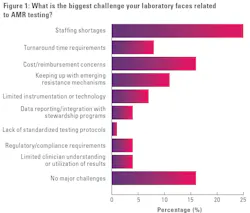
Laboratories continue to face a variety of operational and clinical challenges related to AMR testing. Staffing shortages emerged as the most frequently cited concern, selected by 25% of respondents. Cost and reimbursement issues ranked second at 16%, while 11% identified keeping pace with emerging resistance mechanisms as their primary challenge.
Other concerns included turnaround time requirements, limited instrumentation, regulatory compliance requirements, and challenges integrating laboratory data into antimicrobial stewardship initiatives. Notably, 16% of respondents reported no major challenges, suggesting that some laboratories have developed workflows and resources capable of effectively supporting their AMR programs.

Dee Scott, MLS (ASCP)cm, chemistry section head, generalist, laboratory service excellence ambassador for Memorial Hospital in Carthage, IL. commented on the challenges her lab faces in this area – and how they work to overcome them.
“One of the biggest challenges our laboratory faces related to AMR testing is balancing the need for timely, comprehensive susceptibility results with the resource limitations of a rural critical access hospital. Lower testing volumes, staffing constraints, and limited access to advanced molecular testing platforms can make it difficult to perform the same breadth of AMR testing available in larger reference or tertiary care laboratories.
“To address these challenges, we maintain close collaboration with our reference laboratory partners to ensure access to specialized testing and resistance detection methods when needed. We also work closely with physicians, pharmacists, and infection prevention personnel to promote appropriate culture collection, antimicrobial stewardship, and effective use of susceptibility data. In addition, we continuously monitor updates to testing guidelines and resistance trends to ensure our microbiology practices support accurate and timely patient care while maximizing the resources available to our facility.”
How AMR results are used
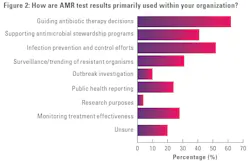
Survey findings reinforce the laboratory’s central role in patient management and infection control. Nearly two-thirds of respondents (62%) reported using AMR test results primarily to guide antibiotic therapy decisions. More than half (52%) use results to support infection prevention and control efforts, while 41% use them to support antimicrobial stewardship programs.
Additional uses include surveillance and trending of resistant organisms (31%), monitoring treatment effectiveness (28%), public health reporting (24%), and outbreak investigations (10%). These findings highlight the growing importance of laboratory-generated AMR data beyond individual patient care.
Future priorities
When asked which AMR-related capabilities they are most interested in expanding during the next one to two years, respondents most frequently selected molecular resistance detection (12%), automation and artificial intelligence tools (10%), and rapid AST (9%). However, uncertainty was also evident, with nearly one-third (31%) reporting they were unsure what future investments their laboratories might pursue.
“The most impactful trend will be the convergence of pathogen detection, resistance detection, and host-response testing into more actionable diagnostic strategies,” said Ephraim Tsalik, vice president and chief scientific officer, infectious disease & acute care, Danaher. “The future is not simply faster tests, but better clinical context. An ideal diagnostic result helps answer: Is this bacterial or viral? Is resistance likely? How sick is the patient? What should the clinician do now? This is more valuable than organism identification alone.”
Respiratory testing trends
Respiratory testing remains a major area of activity for clinical laboratories, although survey results suggest testing demand has stabilized compared with recent years.
In 2025, 75% of respondents reported either moderate or significant increases in respiratory testing volumes. In contrast, this year’s survey found that 46% reported no increase in respiratory testing volume during the past 12 months, while 43% reported a moderate increase and only 11% reported a significant increase. These findings suggest a return toward more predictable seasonal respiratory testing patterns following the heightened demand associated with the COVID-19 pandemic.

“As respiratory testing demand normalizes, laboratories are shifting from a crisis-response model to a more deliberate, clinically driven strategy,” said Tsalik. During the pandemic, the priorities were capacity, speed, supply continuity, and rapid reporting. Now, the question is more nuanced: which test provides the most useful answer for a given patient and care setting?”
“Many laboratories are moving toward tiered testing algorithms,” Tsalik continued. “Targeted assays for high-prevalence pathogens such as SARS-CoV-2, influenza, and RSV may be appropriate for routine seasonal illness, while broader multiplex panels can be reserved for patients with severe disease, immunocompromised status, atypical presentations, outbreaks, or situations where broader results will be actionable. Meanwhile, laboratories are rebalancing their infectious disease menus in areas such as STI and viral hepatitis screening, which were deprioritized during the pandemic.”
Respiratory pathogens of concern
Influenza A/B remained the respiratory pathogen most frequently associated with positive test results, cited by 55% of respondents. However, this represents a substantial decline from 2025, when 82% of respondents identified influenza as one of the most common positive findings.
COVID-19 also showed a notable decline, falling from 63% in 2025 to 32% in the current survey. RSV remained relatively stable at 31%, compared with 33% last year. Other commonly identified pathogens included Strep A/B (19%), rhinovirus (14%), human metapneumovirus (8%), and pneumonia-related infections (9%). Notably, more than one-quarter of respondents (27%) reported they did not know which respiratory pathogens produced the highest number of positive results in their laboratories.
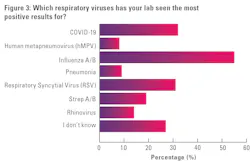
The appearance of human metapneumovirus among reported pathogens may reflect increased awareness and testing for a broader range of respiratory illnesses as laboratories continue to refine respiratory diagnostic strategies.
Hantavirus preparedness
The survey also explored laboratory preparedness for hantavirus testing. Relatively few respondents reported currently performing hantavirus testing, with 5% using RT-PCR and another 5% using PCR methodologies. Smaller percentages reported using serology or rapid testing methods. However, 91% indicated that while they do not currently offer hantavirus testing, they are discussing implementation.
While hantavirus remains relatively uncommon in the U.S., the responses suggest some laboratories are evaluating their preparedness for emerging infectious disease threats.
Respiratory testing methodologies
PCR-based testing remains the dominant respiratory testing methodology, with 51% of respondents reporting its use. Rapid antigen and immunoassay testing followed at 37%, while multiplex molecular syndromic panels and send-out testing to reference laboratories were each reported by 26% of respondents.
Point-of-care molecular testing continues to gain traction, reported by 17% of respondents, while next-generation sequencing remains relatively uncommon at 4%. Viral culture, direct fluorescent antibody testing, and serology continue to play supporting roles in selected clinical settings.
Compared with 2025, molecular methods remain the foundation of respiratory diagnostics, although laboratories appear to be utilizing a broader mix of testing options, including syndromic panels, point-of-care molecular assays, and reference laboratory partnerships.

“Laboratories are increasingly adopting both antigen and molecular testing,” said David Morris, PhD, associate director, product management, SEKISUI Diagnostics. “When the clinical presentation aligns with the antigen assay, rapid tests are often used for quick testing results and operational simplicity. In cases where results are negative but clinical suspicion remains high; labs may use molecular testing. The dual testing modality gives labs more flexibility so they can deliver both rapid and reliable diagnoses.”
Medical laboratory supply chain strategies
MLO also asked respondents whether geopolitical factors are affecting their laboratories’ purchasing and inventory management strategies. The majority (81%) reported no impact, compared with 75% in 2025. However, nearly one in five respondents (19%) indicated geopolitical factors are influencing their purchasing decisions.
Among those reporting an impact, common themes included backorders, delayed deliveries, rising costs, tariffs, and supply shortages. Several respondents specifically referenced challenges obtaining products manufactured overseas and concerns regarding reimbursement failing to keep pace with increased supply costs. Others described the need to place orders earlier, increase inventory monitoring, are carefully balance stock availability against expiration risks.
One respondent noted that tariffs and international shipping delays have increased supply costs without corresponding reimbursement increases. Another described weekly ordering becoming necessary because of limited storage capacity and unpredictable supply availability. Others cited ongoing shortages of laboratory disposable media.
“We have seen customers shift their purchasing strategy from a cost-based approach to a focus on supply chain reliability,” said Morris. “Consistency in laboratory workflows is key for our customers, which is why more are choosing suppliers with products made in the USA.”
Although fewer laboratories reported geopolitical impacts this year than in 2025, the qualitative responses suggest that supply chain resilience remains a priority for many laboratory leaders. Scott commented on her experience:
“Supply chain disruptions, product backorders, rising costs, and other external factors have affected our laboratory's purchasing and inventory management strategies. As a result, we have increased monitoring of inventory levels, adjusted par levels for critical reagents and consumables, and maintained closer communication with vendors regarding product availability and lead times.
“These challenges are amplified by the fact that we are a rural critical access hospital. Unlike larger health systems that may have multiple facilities or centralized supply chains, we often have fewer local resources and less flexibility when critical laboratory supplies are unavailable. Delays in receiving reagents or consumables can have a significant impact on our ability to provide timely testing services to our patients and community.
“To mitigate these challenges, we work collaboratively with neighboring hospitals and laboratory partners to borrow reagents and other essential supplies when shortages occur. Likewise, when supply issues prevent our neighboring hospitals from performing certain tests, our facility assists by performing testing on specimens from their patients. These experiences have required a more proactive approach to inventory management, contingency planning, and regional collaboration to ensure continuity of laboratory operations, maintain quality standards, and support uninterrupted patient care.”
Looking ahead
The 2026 MLO State of the State Industry survey illustrates a laboratory community balancing innovation with operating realities. In antimicrobial resistance testing, laboratories continue to rely heavily on traditional susceptibility testing while exploring opportunities in molecular diagnostics, automation, and rapid testing. At the same time, staffing shortages, and reimbursement pressures remain significant concerns.
Within respiratory diagnostics, testing demand appears to be stabilizing, while molecular methods continue to drive laboratory decision-making. Laboratories are also expanding awareness of emerging pathogens and evaluating preparedness for future infectious disease threats.
As healthcare systems continue to confront evolving infectious disease challenges, clinical laboratories remain at the center of efforts to improve patient outcomes, support stewardship initiatives, and strengthen public health surveillance.
References
- Glasgow KE. Lack of sexually transmitted infection treatment accuracy when relying on syndromic management in an urgent care setting. Sex Transm Dis. 2020;47(9):625-627. doi:10.1097/OLQ.0000000000001216.
- Hansen GT, Moore J, Herding E, et al. Clinical decision making in the emergency department using rapid PCR: results of the CLADE study group. J Clin Virol. 2018;102:42-9. doi:10.1016/j.jcv.2018.02.013.
About the Author
 Kara Nadeau
Kara Nadeau
has 20+ years of experience as a healthcare/medical/technology writer, having served medical device and pharmaceutical manufacturers, healthcare facilities, software and service providers, non-profit organizations and industry associations.