Defining essential functions for medical laboratory technician students: Preparing a competent and safe clinical laboratory workforce

Medical Laboratory Technicians (MLTs) perform routine and moderately complex testing that is fundamental to disease detection, diagnosis, and therapeutic monitoring. Accuracy, efficiency, and adherence to safety standards are critical components of laboratory practice. To support these expectations, the National Accrediting Agency for Clinical Laboratory Sciences (NAACLS) requires accredited programs to define essential functions that students must be able to perform, with or without reasonable accommodations, to complete program requirements and enter professional practice.
Earlier guidance—such as NAACLS News: Essential Functions (Fall 2000) and the Southern Council on Collegiate Education for Nursing (2004)—provided foundational frameworks; however, advances in laboratory automation, informatics, regulatory oversight, and patient‑safety initiatives now necessitate updated, discipline‑specific interpretations. Automation and informatics increasingly shape how these essential functions are performed, but they do not eliminate the need for foundational motor, visual, cognitive, communication, professional, and safety competencies. For example, routine workflow in many laboratories now includes LIS navigation, middleware review, electronic documentation, alarm recognition, exception handling, and basic remote troubleshooting — in addition to hands‑on specimen handling and quality practices. The purpose of this paper is to examine contemporary essential functions utilized by MLT programs and professional organizations and to synthesize common domains that reflect current clinical laboratory practice.
Methods
A qualitative document analysis was conducted using publicly available essential functions and technical standards from accredited MLT programs in the United States. Documents were obtained from institutional websites, student handbooks, and program policy manuals. Additional sources included accreditation standards and professional scope-of-practice statements. Data were coded thematically to identify recurring functional domains relevant to MLT education and practice.
Results
Motor and physical abilities
MLT programs consistently require students to demonstrate sufficient motor skills to perform laboratory procedures safely and accurately. These include fine motor coordination for pipetting and specimen manipulation, manual dexterity for venipuncture and equipment operation, and the ability to move safely within laboratory and patient care environments (Delgado Community College, n.d.; Madison College, n.d.).
Visual and observational skills
Visual acuity is essential for laboratory testing and quality assurance. Students must be able to differentiate color changes, observe microscopic morphology, read instrument displays, and recognize abnormal results or system errors (Bucks County Community College, n.d.; Portland Community College, n.d.).
Communication skills
Effective communication is required for interaction with patients, faculty, peers, and healthcare professionals. Essential functions include the ability to follow written and verbal instructions, document results accurately, and convey information clearly and professionally in both oral and written formats.
Cognitive and critical thinking abilities
Cognitive functions encompass the ability to integrate scientific knowledge, analyze data, troubleshoot problems, and apply judgment in accordance with laboratory protocols. Time management, prioritization, and decision-making are emphasized across programs as essential to safe laboratory practice.
Professional and behavioral attributes
Professional behavior is a core component of essential functions. Expectations include ethical conduct, emotional stability, adaptability, accountability, cultural sensitivity, and adherence to confidentiality and institutional policies. These attributes support teamwork, patient safety, and regulatory compliance.
Safety awareness
All reviewed programs emphasize safety as a fundamental essential function. Students must demonstrate awareness of laboratory hazards, comply with infection control practices, and adhere to biosafety and chemical safety standards to protect patients, coworkers, and themselves.
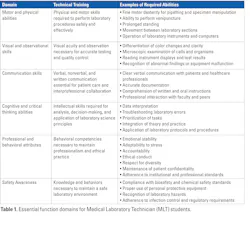
The six essential function domains align with contemporary MLT practice across the pre‑analytic, analytic, and post‑analytic phases of testing. These functions encompass accurate patient identification; appropriate specimen collection methods (including correct devices and containers, processing, transport, and storage) skilled testing performance; and timely, accurate result documentation and communication. Although the domains are presented discretely for readability and policy development, overlap among them is intentional and reflects real‑world laboratory practice, where competencies are integrated rather than isolated (e.g., communication competencies often manifest through professional behaviors such as confidentiality, accountability, and teamwork). The analysis of essential functions documents revealed six recurring competency domains required for successful participation in MLT education and clinical practice. These domains include motor and physical abilities, visual and observational skills, communication skills, cognitive and critical thinking abilities, professional and behavioral attributes, and safety awareness. Together, they represent the functional expectations necessary to meet accreditation requirements and to ensure patient and laboratory safety. A summary of these essential function domains and representative examples is presented in Table 1.
Discussion
The consistency of essential function domains across MLT programs reflects a shared understanding of the competencies required for entry‑level laboratory practice. These domains align closely with NAACLS accreditation standards and with the professional scope of practice outlined by the American Society for Clinical Laboratory Science (ASCLS). Clearly articulated essential functions provide transparency for prospective and current students, facilitate appropriate accommodation discussions, and support programs in meeting accreditation and legal obligations.
For Clinical Laboratory Science educators, standardized essential functions can serve as a framework for curriculum design, student advisement, and clinical affiliation agreements. As laboratory practice continues to evolve, periodic review and revision of essential functions are necessary to maintain relevance and ensure workforce readiness.
Clearly articulated essential functions also support reputable clinical training sites as extensions of classroom learning by providing students with authentic, real‑time testing experiences that utilize current technology and workflows. Clinical rotations expose learners to processes and professional expectations that cannot be fully replicated in the classroom, including the responsibility of producing results that directly inform diagnosis, monitoring, and treatment decisions. Standardized essential functions can further strengthen affiliation agreements, clarify onboarding expectations, and improve employer confidence in the readiness of entry‑level graduates.
This framework is intended to represent entry‑level, technician‑focused expectations consistent with the MLT scope of practice. Although the same functional domains may apply more broadly to MLS roles, MLS practice typically encompasses expanded analytical, supervisory, consultative, and method‑evaluation responsibilities that extend beyond the minimum essential functions required for MLT program completion.
Conclusion
Essential functions represent a critical bridge between academic preparation and clinical laboratory practice. A comprehensive, contemporary framework encompassing physical, cognitive, communication, professional, and safety competencies supports student success, accreditation compliance, and patient safety. Adoption of standardized essential functions across MLT programs may enhance educational consistency and strengthen the clinical laboratory workforce. To further illustrate program effectiveness and workforce readiness, key outcome measures from the Medical Laboratory Technician program are provided below.
Program outcomes since 2018:
- Graduation rate: 100%
- Board/Certification exam pass rate: 100%
- Employment rate post‑graduation (within 6 months): 100%
These outcomes demonstrate the program’s strong performance in preparing graduates for successful entry into the clinical laboratory profession and reinforce the relevance of maintaining well‑defined essential functions as part of an accredited educational framework.
References
- Scope of practice and personnel standards. American Society for Clinical Laboratory Science. Accessed April 22, 2026. https://ascls.org/scope-of-practice/.
- Medical laboratory technician essential functions. Bucks County Community College. Accessed April 22, 2026. https://www.bucks.edu/media/bcccmedialibrary/pdf/MLT-Essential-Functions.pdf.
- Essential functions for the medical laboratory technician. Delgado Community College. Accessed April 22, 2026. https://www.dcc.edu/documents/academics/allied-health/mlt-technical-standards.pdf.
- Medical Laboratory Technician Program essential functions. Madison College. Accessed April 22, 2026. https://madisoncollege.edu/academics/programs/medical-laboratory-technician-accelerated/essential-functions.
- Caruana, L. Essential functions. NAACLS News. 2000;76:12-3.
- Medical Laboratory Technology: Essential functions. Portland Community College. Accessed April 22, 2026. https://www.pcc.edu/programs/medical-lab/functions/.
- Enrollment and progression policies. USC Upstate Academic Catalog. Accessed April 23, 2026. https://academic-catalog.uscupstate.edu/nursing/enrollment-progression-policies/.
About the Author
 Lori Bane, PhD, MT(ASCP)
 Lori Bane, PhD, MT(ASCP)
serves as the Program Director for Medical Laboratory Tech and Phlebotomy Programs at Chattahoochee Technical (Chatt Tech) College. She is a seasoned public health professional and laboratory scientist with over 30 years of experience spanning federal government and clinical laboratory practice.
Jennifer Chin, MLT(ASCP)
serves as the Clinical Coordinator for Chatt Tech College. She is a previous alumnus who has a passion for teaching laboratory technology and helping others.
Patrick Johnson, PhD, MLS(AMT)
is an adjunct professor at Chatt Tech with a strong background in medical laboratory science and healthcare administration and holds a doctorate and master's degrees.
Brittany Devine, MLS(ASCP)
is an adjunct professor at Chatt Tech who brings a strong background in blood banking.
Michael D. Todd, DHSc, MS, MLS(ASCP)
is the Director of Laboratory Services at Wellstar Douglas Hospital. He has a long-standing 28-year career in the Medical Laboratory field.
Pauline Matthews, MHSA, BSMT
is the Assistant Director of Laboratory Operations Management at Kaiser Permanente.
Rickey Triplett, MT (ASCP)
is the Director of Laboratory Services at Wellstar Kennestone Hospital.