Proximity — The best solution for effective eyewash stations
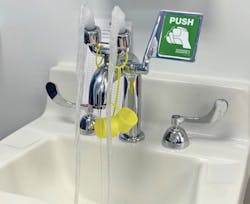
Eyes are among the most delicate and vital organs of the human body — essential to both our work and our quality of life. In medical laboratory environments, protecting those eyes is not just a precaution — it is a professional responsibility.
Each day in the United States, about 2,000 workers sustain job-related eye injuries requiring medical attention. Within hospitals, outpatient clinics, and clinical laboratories, these risks multiply. Laboratory technicians routinely handle corrosive chemicals, biological agents, human tissue, pressurized fluids that can spurt or splash without warning. Even with face shields and goggles, no barrier is perfect. When an accident occurs, seconds count.
The regulatory foundation: A framework for eye protection
Since 1981, the International Safety Equipment Association (ISEA) has published the American National Standard for Emergency Eyewash and Shower Equipment (ANSI Z358.1), which defines performance and installation requirements for emergency eyewash and shower equipment and what “immediate” and “suitable” mean in practice. OSHA 29 CFR 1910.151(c) reinforces this standard by requiring “suitable facilities for quick drenching or flushing” wherever corrosive materials are present.
OSHA’s rule simply states that “where the eyes or body of any person may be exposed to injurious corrosive materials, suitable facilities for quick drenching or flushing…shall be provided within the work area for immediate emergency use.” But to truly ensure worker protection, safety officers and laboratory managers must look beyond mere compliance and adopt best practices that meet — and ideally exceed — the ANSI standard.
In the medical and laboratory world, additional oversight comes from the Joint Commission and the College of American Pathologists (CAP). Joint Commission’s requirements specify that facilities handling chemicals with a pH below 2.0 or above 11.5 — such as glutaraldehyde, formaldehyde, bleach, or sodium hydroxide—must provide accessible eyewash stations.
CAP’s laboratory accreditation program further strengthens these expectations by requiring weekly functional checks to confirm stations operate correctly and are free from contamination or blockage. Compliance with these multiple layers of standards and regulations not only ensures safety but also demonstrates a laboratory’s commitment to a culture of prevention — one that prioritizes the well-being of its workforce.
Eyewash essentials for medical laboratories
For most medical laboratories, the relevant OSHA requirement is the plumbed eyewash station described in 29 CFR 1910.151(c). To meet ANSI/ISEA Z358.1, stations must provide the following:
- Simultaneous dual-eye irrigation with soft, aerated streams
- Stay-open activation, allowing continuous flow without hand pressure
- Activation speed — the valve should activate in one second or less
- Immediate accessibility within 10 seconds (about 55 feet) on the same level as the hazard
- Tepid water between 60 °F and 100 °F, controlled through an ASSE 1071-certified thermostatic mixing valve
- Continuous flow for 15 minutes at ≥ 0.4 GPM per eye
- Proper height, illumination, and clear signage for rapid identification
Touchless operation is increasingly common for faucets, helping minimize cross-contamination during routine handwashing. However, eyewash activation remains manual for precise control and immediate reliability.
Blocked or obstructed access: The space challenge
Traditional eyewash stations often require an injured worker to move 30 to 50 feet to reach help — an impossible task when vision is blurred, or pain is acute. Covering this distance often presents the biggest challenge, and over time, laboratory equipment, storage containers, carts, or temporary items can accumulate near emergency stations, making them difficult to reach.
- The critical danger: Chemical exposures require a worker to flush their eyes within seconds. Any obstruction — even a small one — can reduce that response time and catastrophically worsen the injury severity. Also, in the 50-foot dash to reach the eyewash station, colleagues can inadvertently walk into the path of that panicked lab worker.
- The safety leader's role: Routinely verify a clear, unobstructed path to the eyewash unit. Ensure clear and visible signage is maintained from key work areas. If space is at a premium — such as in smaller labs, educational facilities, or tight workspaces — managers should consider innovative equipment solutions. For environments where square footage is a key concern, utilizing compact emergency eyewash combination units with a faucet for handwashing can offer an accessible, compliant flushing solution without requiring dedicated floor space for a traditional station. Accessibility is not negotiable
Rethinking placement: Safety at the sink
New combination eyewash-and-faucet systems solve this problem by placing emergency response directly at the sink. These compact, integrated devices are gaining popularity in laboratories for several reasons:
- Space efficiency: All laboratories have sinks. Fitting the eyewash station on standard sinks, freeing up bench space.
- Independent supply lines: Eyewash water is isolated from standard tap water to prevent cross-contamination.
- Temperature protection: For use in combination with a ASSE 1071 scald-protection valves to maintain safe, tepid water delivery. Maintaining correct water temperature is a subtle but critical challenge to compliance and user comfort. Water that is too cold can lead a worker to stop flushing prematurely. Excessively warm water may exacerbate chemical reactions or cause a worker to draw away from the stream.
- Simplified plumbing: One fixture performs two functions, reducing installation time and leak points.
By bringing eyewash capability directly to the work surface, laboratories can reduce the distance barrier entirely. This design approach helps lab professionals act immediately at the point of exposure — a critical factor in protecting vision.
Maintaining readiness and compliance
Even the most advanced eyewash station is only as reliable as its maintenance program. ANSI Z358.1 requires weekly activation to ensure full flow and purge stagnant water, plus annual performance testing to verify height, pattern, and temperature.
Routine checks confirm the following:
- Water is immediately available at the nozzle heads.
- Flow is clear of sediment or microbial buildup to prevent erratic spray patterns or insufficient flow volumes. The buildup can lead to splashing that might cause an injured worker to step away during the vital irrigation process.
- Water quality can also be affected by corrosion or chemical degradation in elements of the plumbing system.
- Tepid-water delivery and valve operation remain consistent.
- Access remains unobstructed and signage visible.
Some modern faucet systems now include digital monitoring and scheduled flush features, helping facilities maintain water quality and reduce the risk of microbial growth in supply lines (see Figure 1).
A safer future for laboratory professionals
Integrated combination eyewash faucets demonstrate how thoughtful engineering can directly improve laboratory safety. By eliminating distance, simplifying compliance, and reinforcing preventive maintenance, they embody the next generation of lab safety infrastructure.
When it comes to eye safety, every second saved matters. The lab’s safety mission is to make that first response as immediate and dependable as possible.
A well-designed, well-placed eyewash system is not just a compliance checkbox — it is an investment in vision, productivity, and peace of mind.
Figure 1. Pathogens in stagnant or contaminated water.
Water quality is a crucial element in minimizing the effects of eye accidents. Even the most strategically placed eyewash station can become a source of infection if maintenance is neglected such as regular pipe flushing. Stagnant or contaminated water can harbor dangerous pathogens, including:
- Acanthamoeba: A single-celled organism found in untreated water. It can cause Acanthamoeba keratitis, a painful and difficult-to-diagnose eye infection that mimics other conditions.
- Pseudomonas aeruginosa: This common bacterium can lead to eye, skin, and respiratory infections. If it enters the bloodstream, it may cause systemic illness and has demonstrated resistance to many antibiotics.
- Legionella pneumophila: The bacterium responsible for Legionnaires’ disease thrives in warm, stagnant water and can lead to severe pneumonia. It spreads through inhaled droplets during eyewash activation.
Proper maintenance — regular flushing, disinfection, and adherence to ASSE 1071 water safety guidelines—prevents these invisible threats and ensures that emergency eyewash stations remain a true safeguard, not a secondary hazard.
About the Author
Patrick Tanzillo
is Lab Commercial Manager and the Product Expert for Chicago Faucets. His focus is the laboratory market – providing technical and product support. In addition, Tanzillo provides general customer support and works with sales on national account development.