Advancing laboratory excellence: An interview with the CAP’s Joel Todd Moncur, MD, PhD, MS, FCAP

The College of American Pathologists (CAP) recently announced the offering of 21 new proficiency testing (PT) and external quality assessment (EQA) programs for 2026, including the first HIV-1/HIV-2 molecular detection and differentiation program to be accessible globally. U.S. firsts include the country’s first H5N1 avian influenza and Dengue Virus Serology (DENS) programs.
Medical Laboratory Observer (MLO) spoke with Joel Todd Moncur, MD, PhD, MS, FCAP, Chair of the CAP’s Council on Scientific Affairs about the new programs. Below, Dr. Moncur elaborates on the new offerings and how they will promote excellence in laboratories.
MLO: Can you give us an overview of the 21 new proficiency testing (PT) and external quality assessment (EQA) programs launching in 2026?
Dr. JTM: The College of American Pathologists’ 21 new proficiency testing (PT)/external quality assessment programs for 2026 cover multiple areas of laboratory medicine, including anatomic pathology, endocrinology, general chemistry, genetics and molecular pathology, histocompatibility, immunology, microbiology, and transfusion medicine. These programs were developed in response to advances in clinical testing and reflect the CAP’s commitment to ensuring that proficiency testing evolves in step with laboratory practice.
Highlights from these 21 new PT programs include an H5N1 influenza A detection and subtyping program for U.S. laboratories, a global dengue virus serology program, a new optical genome mapping program, and a reticulocyte calibration verification/linearity tool to help laboratories verify analytical measurement range. Together, these offerings expand CAP’s ability to support laboratories with timely, clinically relevant PT that strengthens quality and confidence in patient testing.
MLO: How do these programs fit into CAP’s mission and vision?
Dr. JTM: Proficiency testing is a critical way the CAP fulfills its mission of serving patients, pathologists, and the public by fostering and advocating excellence in the practice of pathology and laboratory medicine worldwide. The CAP’s scientific committees actively monitor trends and advances in laboratory medicine and work to develop and maintain PT programs that match the testing services provided by clinical laboratories.
These PT/EQA programs are key tools that laboratories can use to support high-quality testing and satisfy accreditation and compliance requirements, including CMS/CLIA and CAP standards. In addition, CAP’s PT programs generate unparalleled data on laboratory practices and performance that the College uses to understand emerging challenges, support continuous improvement, and advocate for policies that strengthen laboratory quality and patient care.
MLO: CAP is the first U.S.-based provider to offer a standalone program for Dengue Virus Serology (DENS). How will it help laboratories address variability in serologic results?
Dr. JTM: CAP proficiency testing samples for the Dengue Virus Serology program consist of homogeneous, clinically relevant specimens that provide laboratories with an outstanding opportunity to compare their results with peer laboratories using a range of assay platforms. By participating, laboratories meet regulatory PT requirements while also receiving objective feedback about how their methods perform in real-world testing.
If a laboratory’s result is an outlier for a specimen, the PT process supports investigation of root causes and implementation of corrective actions. This cycle of peer comparison and continuous quality improvement helps reduce variability and improve consistency in dengue serologic testing over time, which is especially important for laboratories serving endemic regions or evaluating travel-associated infections.
MLO: The new molecular HIV-1/HIV-2 detection and differentiation program is the first of its kind globally. What specific laboratory challenges does this address, and how will it help labs strengthen diagnostic accuracy in HIV testing?
Dr. JTM: Accurately detecting HIV and distinguishing HIV-1 from HIV-2 is clinically important because the distinction can influence treatment decisions and public health response. However, many laboratories have limited external quality feedback focused specifically on molecular HIV-1/HIV-2 differentiation, particularly in settings where HIV-2 is uncommon.
The HVDD program addresses this gap through well-characterized liquid specimens that evaluate the entire molecular workflow, from processing and detection through interpretation and reporting. By comparing results with a broad peer group, laboratories can confirm diagnostic accuracy, identify sources of error, and strengthen confidence in HIV results that directly guide patient management.
MLO: Can you further elaborate on how laboratories can use the Reticulocyte Calibration Verification and Linearity tool to maintain testing accuracy?
Dr. JTM: Reticulocyte testing is widely used to assess marrow response and guide anemia management, so laboratories must ensure accurate performance across the full analytical measurement range. The Reticulocyte Calibration Verification and Linearity tool provides laboratories using Sysmex reticulocyte methods with standardized materials to verify calibration and confirm linearity across reportable concentrations.
Laboratories run multiple levels of the CAP materials and compare observed results to expected targets to confirm that instrument performance remains accurate and linear. If drift or non-linearity is detected, laboratories can intervene early with recalibration or maintenance. This supports CAP and CMS/CLIA requirements for analytical measurement range and calibration verification, while also strengthening ongoing quality assurance for reticulocyte testing.
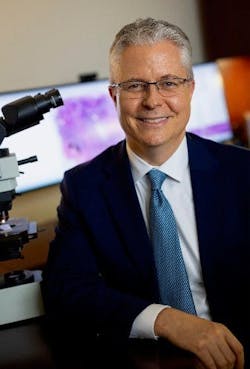
Joel Todd Moncur, MD, PhD, MS, FCAP, Colonel, United States Army (Ret) serves as Chief Medical Officer and Deputy Director of the Joint Pathology Center (JPC) in Silver Spring, Maryland—formerly the Armed Forces Institute of Pathology. A molecular, genetic, and genitourinary pathologist, Dr. Moncur earned his MD from Dartmouth’s Geisel School of Medicine and both his MS and PhD from Dartmouth College.
Dr. Moncur previously served as Director of the Joint Pathology Center and as Chair of Pathology at Walter Reed National Military Medical Center. In 2020, he initiated the digital transformation of the JPC’s historic pathology repository—one of the nation’s largest—digitizing over 6 million glass slides and developing AI-ready datasets. His team’s work has supported prototype machine learning algorithms, including one that detects, grades, and predicts the prognosis of prostate cancer.
Dr. Moncur’s research spans molecular oncology and infectious diseases, with publications on the neuropathology of COVID-19, the pathology of measles as a re-emerging disease, and optimal testing for human papillomavirus in head and neck cancers.
Within the College of American Pathologists (CAP), Dr. Moncur serves on the Board of Governors, chairs the Council on Scientific Affairs, and is a member of both the Information Technology Leadership Committee and the Finance Committee. He previously chaired the CAP Molecular Oncology Committee and served as its advisor.
About the Author
 Erin Brady
 Joel Todd Moncur, MD, PhD, MS, FCAP, Colonel, United States Army (Ret)
Joel Todd Moncur, MD, PhD, MS, FCAP, Colonel, United States Army (Ret)
serves as Chief Medical Officer and Deputy Director of the Joint Pathology Center (JPC) in Silver Spring, Maryland—formerly the Armed Forces Institute of Pathology. A molecular, genetic, and genitourinary pathologist, Dr. Moncur earned his MD from Dartmouth’s Geisel School of Medicine and both his MS and PhD from Dartmouth College.
Dr. Moncur previously served as Director of the Joint Pathology Center and as Chair of Pathology at Walter Reed National Military Medical Center. In 2020, he initiated the digital transformation of the JPC’s historic pathology repository—one of the nation’s largest—digitizing over 6 million glass slides and developing AI-ready datasets. His team’s work has supported prototype machine learning algorithms, including one that detects, grades, and predicts the prognosis of prostate cancer.
Dr. Moncur’s research spans molecular oncology and infectious diseases, with publications on the neuropathology of COVID-19, the pathology of measles as a re-emerging disease, and optimal testing for human papillomavirus in head and neck cancers.
Within the College of American Pathologists (CAP), Dr. Moncur serves on the Board of Governors, chairs the Council on Scientific Affairs, and is a member of both the Information Technology Leadership Committee and the Finance Committee. He previously chaired the CAP Molecular Oncology Committee and served as its advisor.