Analytical instrumentation market strengthened by pharmaceutical and diagnostics demand
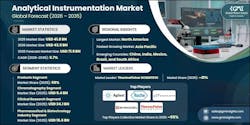
The global analytical instrumentation market was valued at USD 41.8 billion in 2025 and is expected to expand steadily over the next decade. According to the latest report published by Global Market Insights Inc., the market is projected to grow from USD 43.5 billion in 2026 to USD 71.9 billion by 2035, registering a compound annual growth rate (CAGR) of 5.7% during the forecast period. This growth trajectory reflects the rising importance of advanced analytical tools across pharmaceutical research, clinical diagnostics, life sciences, and industrial applications.
Market expansion is primarily driven by increasing research and development (R&D) spending by pharmaceutical companies and government-funded research organizations. As drug discovery pipelines become more complex and regulatory scrutiny intensifies, the demand for high-precision analytical instruments continues to rise. These tools play a critical role in ensuring data accuracy, method validation, and regulatory compliance across drug development and quality control workflows.
Technological advancements in analytical instrumentation are further strengthening market growth. Innovations in chromatography, spectroscopy, mass spectrometry, and molecular analysis have significantly improved testing accuracy, speed, and operational efficiency. The integration of automation, digital interfaces, and advanced data analytics is enabling laboratories to process larger sample volumes with greater reproducibility, supporting high-throughput testing and faster decision-making.
The growing adoption of analytical instrumentation in precision medicine applications is also contributing to market momentum. Personalized therapies require detailed molecular and biomarker analysis, driving the need for sophisticated analytical platforms capable of delivering highly sensitive and reliable results. As precision medicine gains wider acceptance in oncology, immunology, and rare disease treatment, analytical instrumentation is becoming increasingly central to both research and clinical settings.
Based on products and services, the market is segmented into products and services & consumables. The products segment accounted for 58% of the global market in 2025, reflecting strong demand for advanced analytical instruments across pharmaceutical R&D, clinical diagnostics, and industrial testing environments. This dominance is supported by continuous technological innovation, stringent regulatory requirements, and the growing emphasis on precision and reproducibility in analytical testing. The products segment is expected to exceed USD 40.5 billion by 2035, expanding at a CAGR of 5.4% during the forecast period.
Regionally, North America dominated the analytical instrumentation market, accounting for 37.7% of the global market share in 2025. The region’s leadership is underpinned by a mature pharmaceutical and biotechnology industry, robust clinical research activity, and widespread adoption of advanced laboratory technologies.
In the U.S., the analytical instrumentation market was valued at USD 13.2 billion in 2022 and USD 13.4 billion in 2023. The market grew to USD 13.9 billion in 2024 and reached USD 14.6 billion in 2025. It is anticipated to expand at a CAGR of 5.8% between 2026 and 2035. Growth in the country is driven by sustained investments in pharmaceutical R&D, a strong diagnostics sector, and strict regulatory standards that necessitate high-quality analytical testing across healthcare and industrial applications.
Overall, the global analytical instrumentation market is positioned for sustained growth over the coming decade. As pharmaceutical research intensifies, precision medicine advances, and analytical technologies continue to evolve, demand for reliable, high-performance instrumentation is expected to remain strong. Continued innovation in analytical platforms will play a critical role in enhancing research efficiency, ensuring regulatory compliance, and supporting the next generation of scientific and healthcare advancements.