From GP17 to QMS28: Why CLSI reframed laboratory safety, and what it means for your program

Most laboratory safety programs are built on the premise that if you follow the policies and procedures, nothing goes wrong. But anyone who has worked in a clinical laboratory knows that compliance alone does not prevent accidents. The lab’s safety culture, training programs, and knowledge of the hazards have a greater influence on risk reduction. That is why solely relying on lagging indicators like injury reports and audit scores to judge your safety program rarely leads to improvements. The most impactful safety programs are the ones that seek out hazards and put steps in place before something happens. The Clinical Laboratory and Standards Institute (CLSI) recognized this need and created a guide to move lab leaders from a reactive mindset to one that is more proactive. One where the lab recognizes the risks upfront and can create a system around those risks to keep them at bay.
Laboratory safety management
In 2025, CLSI took two very successful general procedures (GP), GP17-A3, Clinical Laboratory Safety and GP05-A3, Clinical Laboratory Waste Management, and merged them into a new document with a different approach to safety. Enter QMS 28, Laboratory Safety Management. While these earlier guidelines were foundational to safe laboratory operations, they were structured separately, forcing laboratories to cross-reference multiple documents to build a complete safety program. Labs were required to take different pieces of safety and try to make them fit as a whole, like trying to complete a puzzle using several different sets. By embedding safety within the Quality Management System (QMS) framework, CLSI has provided laboratories with a structure that replaces the splintered sections of safety into a more integrated system that supports the upfront risk management approach that is essential for continuous improvement.
QMS28 does more than just combine safety and waste elements into a single, cohesive framework. It aligns laboratory safety directly with the CLSI QMS model that incorporates safety in the pre-examination, examination, and post-examination phases of laboratory operations, also known as the laboratory path of workflow. CLSI realizes that hazards exist in every stage of laboratory testing, and keeping safety at the forefront is essential for success.
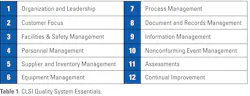
The QMS model is built from 12 Quality System Essentials (QSEs) elements (see Table 1). Each element is critical for a lab to be successful, and when one is missing, the laboratory path of workflow is in jeopardy. Having facilities and safety management included in the QMS model ensures that risk management is embedded in every stage of safety operations, rather than treated as a standalone function.
For laboratory leaders, this shift requires more than updating policies or procedures. It requires a change in perspective. Safety must be viewed not as an obligation, rather a system that can be designed, measured, and improved over time. This may involve rethinking how hazards are identified, and how labs prepare to handle the risks. CLSI made a small, but significant update in QMS28 to aid with this change in thinking. In Chapter 4 of QMS28, Planning for Safety, CLSI added the Identifying and Assessing Hazards section to highlight the importance of a risk assessment. Before a lab can put steps in place to remove workplace hazards, the hazards must first be identified. The expanded risk assessment guide found in Appendix A not only offers a risk assessment form, but guides readers in proper risk identification and how to implement control measures that reduce the risk to levels appropriate for staff to work safely.
Perhaps one of the greatest advancements is not how this CLSI guideline can be used, but where. QMS28 expands beyond U.S. specific regulations like OSHA, NFPA, and EPA, to be adaptable across the globe. The new guideline aligns laboratory safety with international standards such as ISO 15189, 15190, and the Global Harmonizing System (GHS), making it relevant to laboratories worldwide while supporting diverse regulatory environments. Rather than prescribing country-specific recommendations, it provides a flexible framework that allows laboratories to apply core safety principles within their local regulatory structure while still maintaining consistency in approach.
Waste management
In GP05, waste was largely addressed through a regulatory lens. Laboratories were guided on classification, labeling, storage, and disposal, all essential components for compliance. Those elements remain in QMS28, but the framing has changed significantly.
By consolidating safety and waste management into a unified structure, QMS28 transforms waste handling into a controllable, auditable process within the broader laboratory system. It shifts the priority from managing waste downstream to minimizing it upstream. Instead of focusing only on what happens after waste is generated, laboratories are challenged to ask more fundamental questions like “Why is this waste being generated in the first place?” and “What can we do to reduce the amount of waste we generate?”
This change in thinking aligns directly with the hierarchy of controls, prioritizing elimination and substitution over administrative and engineering controls. Laboratories are encouraged to examine their chemical inventories, identify opportunities to replace hazardous substances with less dangerous alternatives, and redesign workflows to reduce waste generation at the source. Hazardous waste removal can be a significant cost burden on a laboratory. Therefore, while this change of focus can result in hazard reduction, there is also potential for cost savings. Laboratories are not just improving waste compliance; they are reducing risks in a meaningful and sustainable way.
Competency and education
Another critical advancement in QMS28 is how it reframes education and training. Traditional laboratory safety programs often rely on attendance-based metrics. Staff complete some required training sessions, they sign off on documentation, and move on. Again, while this approach satisfies regulatory expectations, it does not guarantee that safe behaviors are consistently practiced.
QMS28 moves beyond this outdated model by emphasizing demonstrated competence. Chapter 11 establishes a framework that links key moments in education like initial training, competency assessment, and ongoing/refresher training, into a continuous process. The emphasis is no longer on “did the training occur,” but rather “do staff know how to work safely by demonstrating that on a daily basis.”
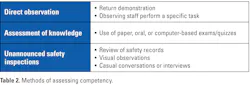
To support this, QMS28 outlines practical methods for competency assessment, including direct observation, knowledge-based evaluations, and unannounced safety inspections (see Table 2). These assessment tools provide laboratories with real-time insight into how safety performance is actually affecting the lab, not just how it is intended to be.
There is little doubt that this shift has important implications for risk reduction. By evaluating competency continuously, laboratories can identify performance gaps before they lead to incidents. Instead of reacting to events after they occur, leaders can intervene earlier with targeted coaching, retraining, or process adjustments. Over time, this creates a more resilient safety culture, one that reinforces safe behaviors rather than relying on policy enforcement.
Moving forward
QMS28 does not simply replace two legacy documents. It reframes laboratory safety as a core component of quality management. It provides a roadmap for moving beyond compliance towards a model of safety that is proactive, measurable, and sustainable. The challenge moving forward is implementation. Laboratories that embrace this systems-based approach may be better positioned to manage risk, support their staff, and adapt to evolving regulatory and operational demands. The most important change introduced by QMS28 is not structural, it is cultural. It shifts the focus from what we tell people to do, to what our systems enable them to do consistently. And in a field where small failures can accumulate into significant risk, that shift is not just nice to have, it is necessary.
About the Author
 Jason P. Nagy, PhD, MLS (ASCP)CM,QLS
Jason P. Nagy, PhD, MLS (ASCP)CM,QLS
is the Laboratory Safety Support Coordinator at Sentara Health, a multi-hospital system in Virgina and North Carolina. Jason brings almost 20 years of laboratory experience to the lab as a medical laboratory scientist (MLS) and more recently in laboratory safety and education roles.