Advanced deep learning system achieves 94.5% accuracy in melanoma diagnosis
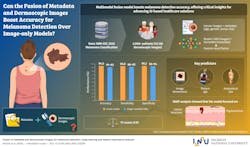
Scientists have developed an advanced artificial intelligence (AI) model that can detect melanoma more accurately by combining skin images with patient metadata. The study achieved 94.5% accuracy, marking a breakthrough in AI-powered early detection of melanoma.
Professor Gwangill Jeon from the Department of Embedded Systems Engineering, Incheon National University, South Korea, in collaboration with the University of West of England (UK), Anglia Ruskin University (UK), and the Royal Military College of Canada, created a deep learning model that integrates patient data and dermoscopic images. The study was made available online on June 6, 2025, and was published in Volume 124 of the journal Information Fusion on December 1, 2025.
Using the large-scale SIIM-ISIC melanoma dataset, which contains over 33,000 dermoscopic images paired with clinical metadata, the team trained their AI model to recognize subtle links between what appears on the skin and who the patient is. The model achieved 94.5% accuracy and an F1-score of 0.94, outperforming popular image-only models such as ResNet-50 and EfficientNet.
The researchers also performed feature importance analysis to make the system more transparent and robust. Factors like lesion size, patient age, and anatomical site were found to contribute strongly for accurate detection. These insights can help doctors understand and provide a roadmap to trust the diagnosis performed by AI.
Prof. Jeon says, “The model is not merely designed for academic purposes. It could be used as a practical tool that could transform real-world melanoma screening. This research can be directly applied to developing an AI system that analyzes both skin lesion images and basic patient information to enable early detection of melanoma.”
In the future, the model could power smartphone-based skin diagnosis applications, telemedicine systems, or AI-assisted tools in dermatology clinics, helping reduce misdiagnosis rates and improve access to care. Prof. Jeon explains, “The study represents a step forward toward personalized diagnosis and preventive medicine through AI convergence technology.”