Single sample simplicity for sexual health: The diagnostic journey of a single swab
Sexual health remains an essential pillar of care for all Americans. However, accessing timely testing is not always straightforward. For women and people with a cervix, access to healthcare providers––including obstetrician-gynecologists (OB-GYNs)––can be difficult, particularly in rural settings. A recent Kaiser Family Foundation analysis found a ratio of approximately one OB-GYN for every 2,600 women in the United States, driving long wait times for appointments.1 This can reduce the frequency of sexual health specialist appointments, potentially redirecting individuals to primary- or urgent-care settings when symptoms arise.
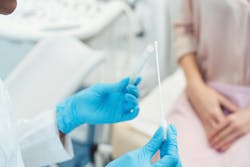
Diagnostic solutions need to be flexible to adapt to these different healthcare settings, patient schedules and preferences. Fortunately, a variety of innovations are helping maximize these healthcare encounters. One prime example is the wide array of testing that can now be performed using a single vaginal swab (potentially self-collected). This one specimen can be used to identify both symptomatic and asymptomatic infections at the point of care and in clinical laboratories. Ongoing innovation is also helping clinical labs efficiently process many sexual health tests on a single, fully automated platform to overcome previous complexities.
Flexible testing at the point of care
One of the challenges with sexual health testing for women is that different infections can cause overlapping symptoms or no symptoms at all. While many infections can be readily treated, selecting the right medication is essential, as the treatment for one condition may be totally ineffective against another. Co-infections are also relatively common in certain regions and demographics.2 Accurately diagnosing the cause of the infection is therefore critical to ensure proper treatment, prompt symptomatic relief, and to stop the spread of infection.
In settings such as urgent care clinics and emergency departments, point-of-care (POC) testing with gold-standard PCR technology can return accurate results in as little as 20 minutes.3 Practitioners can use multiplex assays to test for many common sexually transmitted infections (STIs), including Chlamydia trachomatis (CT), Neisseria gonorrhoeae (NG), and Mycoplasma genitalium (MG), simultaneously. If the sample is positive for one or more infections, the appropriate treatment and counseling can be provided within the same appointment.
With the latest technologies, specimens such as a vaginal swab that are used in point-of-care settings can also be used with laboratory-based tests, further streamlining the continuum of care.
Expanding test menus and platform consolidation in clinical labs
Point-of-care testing and patient self-collection are excellent tools for enhancing the frontline diagnostic experience. However, it does not stop there. Many instruments today require minimal sample processing volumes, which help conserve the specimen. Combined with more standardized instrumentation, the same vaginal swab can now be used to run point-of-care assays and be sent for additional testing in a clinical lab.
In laboratories, the menu of potential assays for a single specimen continues to expand. For example, a new Bacterial vaginosis and Candida vaginitis (BV/CV) assay is currently in development. Bacterial vaginosis is characterized by an imbalance in the vaginal microbiota caused by overgrowth of normal bacteria. More than 50% of women diagnosed with BV experience recurrence within 12 months,4 and it is associated with an increased risk of HIV infection, pelvic inflammatory disease, and adverse pregnancy outcomes. Candida vaginitis, by contrast, is a fungal infection caused by the overgrowth of Candida species in the vulvovaginal area. It can cause significant discomfort and may negatively impact quality of life.5 The overlapping symptoms of BV, CV, and other causes of vaginitis complicate diagnosis and treatment, making it an important test for symptomatic patients. Processing BV/CV assays using the same vaginal swab sample used for CT/NG/MG/TV testing provides another opportunity for healthcare practitioners to simplify the patient experience, removing the need for additional sampling events and collection devices.
The benefits of single-sample simplicity also extend to clinical laboratory operations. Many labs today are burdened with managing multiple platforms, vendors, and complex workflows for different tests. This leads to increased hands-on time, training needs, and supply chain complexity. Fortunately, technological advances are helping to streamline these processes. Labs can now adopt a unified, high-throughput molecular assay platform for sexual health testing, so a single sample can be run on a fully automated system––increasing value without adding complexity. This provides clinically actionable results, aligned with current guidelines, for many thousands of patients in the most efficient way possible. Ready-to-use reagents further reduce manual tasks associated with sample preparation and cleaning maintenance, while increasing standardization across laboratories and different lab technicians.
If results are positive, reflex testing using the same vaginal swab sample can then guide which therapies may be most effective. Additionally, these streamlined systems allow additional sample characterization for research or epidemiological tracking using the same vaginal swab sample. For example, easy-to-use tests now allow labs to detect mutant DNA markers, which can be associated with antibiotic resistance.6 This allows labs to build out customized menus based on the current needs of the populations they serve.
Removing barriers to sexual health testing
We are now moving toward an era where a variety of sexual health tests can be processed using a single vaginal swab sample. Laboratories can seamlessly run many assays using the same specimen and the same unified diagnostic platform. At the point of care, single-sample simplicity allows healthcare providers to maximize patient interactions at a time when scheduling appointments and visiting the doctor in person can be challenging. Maximizing a single sample demands less from the patient and gives the option for self-collection, overcoming barriers to access for some individuals. It paves the way for same-day treatment and for the fast relief of symptoms. Finally, given the nature of infectious organisms, timely sexual health testing and treatment can limit further spread, benefiting the broader population.
References
- Long M, Rae M, Winger A, Pestaina K. Access to OB-GYNs: Evaluating workforce supply and ACA marketplace networks. KFF. July 10, 2025. Accessed November 18, 2025. https://www.kff.org/affordable-care-act/access-to-ob-gyns-evaluating-workforce-supply-and-aca-marketplace-networks/.
- Tran A, Amamoto A, Bates M, Leonard J, Carrico V, Pride DT. Prevalence of Mycoplasma genitalium in a Southern California patient population. Diagn Microbiol Infect Dis. 2025;114(2):117130. doi:10.1016/j.diagmicrobio.2025.117130.
- Roche receives FDA clearance with CLIA waiver for cobas liat molecular tests to aid in diagnosing sexually transmitted infections at the point of care. Roche Diagnostics. January 22, 2025. Accessed November 18, 2025. https://diagnostics.roche.com/us/en/news-listing/2025/roche-receives-fda-clearance-with-clia-waiver-for-cobas-liat-molecular-tests-to-aid-in-diagnosing-sexually-transmitted-infections-at-the-point-of-care.html.
- Abbe C, Mitchell CM. Bacterial vaginosis: A review of approaches to treatment and prevention. Front Reprod Health. 2023;5:1100029. doi:10.3389/frph.2023.1100029.
- Willems HME, Ahmed SS, Liu J, Xu Z, Peters BM. Vulvovaginal candidiasis: A current understanding and burning questions. J Fungi (Basel). 2020;6(1):27. doi:10.3390/jof6010027.
- TIB Molbiol pre-designed assays for use on the cobas omni utility channel on cobas 5800/6800/8800 Systems: UC-TIB-MG Resistance. Roche Diagnostics. Accessed November 18, 2025. https://diagnostics.roche.com/us/en/products/product-category/tib-molbiol-pre-designed-assays-for-use-on-the-cobas-omni-utilit.html#productInfo.
About the Author
 Samantha A. Byrnes, MPH, PhD
Samantha A. Byrnes, MPH, PhD
is a Senior Scientific Manager at Roche Diagnostics. She has a decade of experience developing a range of diagnostic technologies for detection of sexually transmitted infections (STIs) and other infectious diseases in multiple healthcare settings, including at the point of care. At Roche, Dr. Byrnes serves as the strategy lead covering sexual health and HPV/cervical cancer on the molecular Medical Scientific Affairs team. She obtained her Doctorate of Bioengineering and a Masters of Public Health from the The University of Washington Departments of Bioengineering and Global Health, respectively.