Mass spectrometry in the clinical laboratory
Mass spectrometry (MS) is a method of chemical analysis that measures the mass-to-charge ratio (m/z) of atoms or molecules in a sample. It helps to determine the exact molecular weight of the components in the sample and thereby identify unknown compounds.
Mass spectrometry is often paired with chromatography—gas (GC/MS) or liquid (LC/MS) chromatography, where chromatography separates the components of an unknown compound and mass spectrometry analyzes the components for accurate identification. MS is routinely used in toxicology, endocrinology, newborn screening, microbiology, therapeutic drug monitoring, proteomics, and precision medicine.
Evolution of MS in clinical laboratory
Gas chromatography (GC) mass chromatography (MS) was first used in clinical laboratories in the 1960s, especially in toxicology and for highly specific diagnostic issues, such as the assessment of rare metabolic diseases like Refsum's disease. However, it was a complex and demanding procedure.1
The development of electrospray ionization (ESI) and the triple-quadrupole mass spectrometer in the 1980s facilitated the emergence of the tandem mass spectrometry (MS/MS), particularly LC-MS/MS (liquid chromatography–tandem mass spectrometry) in clinical laboratories from the 1990s. From the late 1990s onward, mass spectrometry was being used for the analysis of clinically relevant molecules, including thermo-labile compounds. However, due to the complex nature of the technology and high cost, it was not being routinely used in clinical laboratories globally. In the early 2020s, the first fully automated mass spectrometry system became available.1
Types of mass spectrometers and their major applications
There are different types of mass spectrometers; however, the main components are as follows:2
- An ionizer that ionizes a sample’s atoms or molecules
- A mass analyzer
- A detector that detects or counts the number of ions of a specific mass to charge ratio
Various types of mass spectrometers use different ionization sources, mass analyzers, and detectors. Listed below are the six major types of mass analyzers:
- Quadrupole mass analyzer – mostly used for analyzing and quantifying small molecules. They are used in biomedical research and clinical applications.3
- Newborn screening
- Endocrine testing
- Therapeutic drug monitoring
- Targeted proteomics
- Clinical and forensic toxicology and
- Targeted metabolomics
- Time-of-flight (TOF) mass analyzer – has been used for substances with higher molecular masses, such as proteins. MALDI/TOF has extensive usage in the medical field as below:4
- Clinical microbiology – identification of bacteria, fungi, viruses, antibiotic resistance, etc.
- Establishing biomarkers for various cancers, diabetes mellitus etc.
- Study of drug metabolism
- Study of proteins and peptides in proteomics research
- Magnetic sector mass analyzer, also called High-resolution mass spectrometry (HRMS) – is used in the following:
- Pharmaceutical and fermentation industries2
- Environmental analysis5
- Geochemistry etc.6
- Electrostatic sector mass analyzer – is used in the following:
- Plasma diagnostics7
- Space exploration2
- Quadrupole ion trap (QIT) mass analyzer – is used in the following:
- Biomolecule and peptide sequencing8
- Environmental analysis for detecting trace contaminants9
- Detecting volatile organic compounds (VOCs), environmental pollutants, and illicit drugs in complex mixtures10
- For structural elucidation of complex organic compounds9
- Ion cyclotron resonance mass analyzer – is used in the following:
- Medical research - in advanced cancer treatment, metabolomics2
Testing procedure of mass spectrometry11
Mass spectrometry analyzes samples through five key stages: ionization, acceleration, deflection, detection, and vacuum maintenance.
1) Ionization
Atoms are ionized by removing an electron to form positively charged cations — the only ion type mass spectrometers analyze. In GC/MS, electron ionization bombards molecules with high-energy electrons (~70 eV), fragmenting them into reproducible, identifiable patterns. LC/MS techniques operate at atmospheric pressure. Electrospray ionization and atmospheric pressure chemical ionization are soft ionization techniques that leave the molecular ion largely intact in the source. Electrospray ionization uses a combination of voltage, heat, and air to produce successively smaller droplets from the liquid, eluting off a chromatographic column. As the solvent evaporates, the droplets become more concentrated, significantly increasing charge per unit volume. Ions accumulated at the droplet surface desorb from the liquid into the gas phase, allowing these gas phase ions to enter the mass spectrometer for analysis. In addition, complete evaporation of the solvent liberates large ions, such as proteins, producing the necessary gas phase ions for analysis. Atmospheric pressure chemical ionization produces ions using a combination of heat to completely vaporize the sample and plasma produced by an electrical discharge, commonly referred to as a corona discharge. The corona discharge ionizes the evaporated solvent, and through physical interaction with gaseous sample components, including the analytes of interest, positive or negative ions are formed.
2) Acceleration
All cations are accelerated to equal kinetic energy through slits in the apparatus, feeding into an ion beam where the mass analyzer begins separating ions by their mass-to-charge ratio (m/z).
3) Deflection
A magnetic field deflects the cations based on their mass and charge. Mass and deflection are inversely proportional, whereas charge and deflection are directly proportional. Therefore, ions with a lower mass are deflected more, and ions with a higher positive charge experience greater deflection. This determines each ion’s mass to charge (m/z) ratio. Since most ions carry a 1+ charge, their m/z value typically equals their molecular weight.
4) Detection
A detector quantifies the positive ions, and the vacuum removes the neutral ions. The most common detection method is the electron multiplier where a series of dynodes with increasing potentials are linked. When ions strike the first dynode surface, electrons are emitted. These electrons are attracted to the next dynode, where more secondary electrons are emitted due to the higher potential of subsequent dynodes. A cascade of electrons is formed at the end of the chain of dynodes, resulting in overall signal amplification on the order of 1 million or greater.
5) Vacuum
Mass spectrometers operate under low pressure, which creates a vacuum effect as there is less probability that ions collide with one another in the apparatus. This environment enables the proper separation of cations from the neutral ions, as the vacuum removes the neutral molecules.
Advantages of mass spectrometry in clinical applications12
Mass spectrometry, especially in combination with liquid chromatography (LC), has revolutionized clinical chemistry and proved to be a very useful tool in identifying disease biomarkers and quantifying biomolecules for diagnostic and prognostic purposes. The characteristics that set them apart are as follows:
- High specificity and sensitivity – Clinical mass spectrometry has largely replaced traditional immunoassays for low-concentration analytes by virtue of its high sensitivity (low limit of detection (LoD)/limit of quantitation (LoQ)) and very high chemical specificity that prevents the false positives and cross-reactivity that are common in older immunoassay methods. The LoD of mass spectrometry ranges from picograms to nanograms per milliliter (pg/mL to ng/mL).
- Multiplexing capabilities – Mass spectrometry (MS) techniques coupled with liquid chromatography (LC-MS) have the capability to simultaneously analyze multiple analytes in a single run, enabling comprehensive metabolomic and proteomic profiling. The ability of MS to detect and quantify many thousands of metabolite features simultaneously has revolutionized the field of metabolomics, allowing for in-depth characterization of complex biological samples. Using advanced MS-based technology it is now possible to routinely detect and quantify thousands of proteins. Multiplexing capabilities have improved the throughput and quantitative capabilities of MS-based proteomics, enabling the comparison of protein expressions across multiple samples in a single experiment.
- Versatility – Mass spectrometry (MS) is highly versatile as it can be applied to a wide variety of biomolecules, including proteins, peptides, metabolites, and drugs. Moreover, coupling with liquid chromatography (LC) or using techniques such as ion mobility spectrometry (IMS), improves the separation and analysis of the MS, improving the versatility of MS to increase further.
- Isotope dilution internal standardization – Isotope dilution internal standardization in MS enables highly accurate quantification by compensating for matrix effects in complex biological matrices, such as plasma, serum, and urine. Recent MS technologies (high-resolution accurate-mass (HRAM) spectrometers and tandem MS) have further improved this capability enabling more reliable and reproducible results.
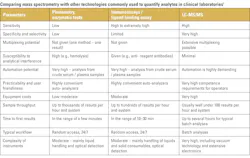
Main areas of application for LC-MS/MS technology in clinical laboratories1
- Newborn screening for inherited metabolic diseases
- Therapeutic drug monitoring
- Clinical toxicology
- Endocrinology
- Metabolic disease
- Trace elements
- Microbial pathogen differentiation
Challenges for the application of LC-MS/MS in routine medical laboratories
- Highly heterogeneous system configurations.
- Multi-step complex workflows with several quantitative pipetting steps, manual labelling, manual positioning of plates or vials, manual creation of sample lists, etc.
- Highly laboratory-specific workflows, with little process-related standardization.
- A wide range of possible operator errors, in contrast to standard clinical laboratory analyzer systems.
- Result validation requires review of large amounts of metadata, typically under time pressure and without sufficient software support.
- Implementation and maintenance of methods demand profound expert knowledge, and there is a shortage of experts.
- Very high instrument costs, which often cannot be amortized over extended periods.
Future trend for mass spectrometry in clinical laboratories
Fully automated LC-MS/MS–based analyzer systems are now available. This has enabled a few mass spectrometry assays such as the Ionify steroid assays and Ionify 25-Hydroxy Vitamin D total test to be designated as moderately complex by the U.S. Food and Drug Administration. With the advancement in robotics and artificial intelligence (AI), it can be envisioned that mass spectrometry (MS) will transition from a niche, expert-dependent tool to a highly automated, AI-driven core technology in routine laboratory medicine.
Conclusion
Mass spectrometry has evolved from a complex research tool into an indispensable platform in clinical diagnostics. Driven by automation and artificial intelligence, it is rapidly shedding its dependence on specialized operators, broadening access across diverse healthcare settings. The emergence of miniaturized, point-of-care MS instruments will soon bring gold-standard analytical accuracy directly to the patient’s bedside.14 Coupled with multiomics integration, mass spectrometry is poised to become the cornerstone of precision medicine — making its universal adoption in clinical laboratories not only inevitable but imminent.
References
- Vogeser M, Habler K. Applications of mass spectrometry in the routine diagnostic medical laboratory - a status report 2025. J Chromatogr B Analyt Technol Biomed Life Sci. 2026;1273(124958):124958. doi:10.1016/j.jchromb.2026.124958.
- Types of mass spectrometers and their uses. Conquer Scientific. June 2, 2023. Accessed June 9, 2026. https://conquerscientific.com/types-of-mass-spectrometers-and-their-uses/.
- Tsakalof A, Sysoev AA, Vyatkina KV, et al. Current role and potential of triple quadrupole mass spectrometry in biomedical research and clinical applications. Molecules. 2024;29(23):5808. doi:10.3390/molecules29235808.
- Andreadi A, Tsivelekidou E, Dermitzakis I, et al. Innovations in MALDI-TOF Mass Spectrometry: Bridging modern diagnostics and historical insights. Open Life Sci. 2025;20(1):20251136. doi:10.1515/biol-2025-1136.
- Selby KG, Hubecky EM, Zerda-Pinto V, Korte CE, Bressendorff GA, Tucker KR. Mass spectrometry imaging for environmental sciences: A review of current and future applications. Tren Environ Anal Chem. 2024;42(e00232):e00232. doi:10.1016/j.teac.2024.e00232.
- Gäbler HE. Applications of magnetic sector ICP-MS in geochemistry. J Geochem Explor. 2002;75(1-3):1-15. doi:10.1016/s0375-6742(01)00197-2.
- EQP. Mass And Energy Analyser For Plasma Diagnostics. Hiden Analytical. Accessed June 9, 2026. https://www.hidenanalytical.com/wp-content/uploads/2016/08/EQP-poster_A1_print.pdf.
- Cruz ER, Johnson ANT, Pujari V, et al. Expanding targeted instrumentation for discovery applications: Complement reporter ion quantification with a quadrupole-ion trap instrument. J Proteome Res. 2025;24(9):4611-4622. doi:10.1021/acs.jproteome.5c00356.
- Workman J Jr. Advancements and emerging techniques in mass spectrometry: A comprehensive review. LCGC Supplements: Hot Topics in Mass Spectrometry. November 7, 2024. Accessed June 9, 2026. https://www.chromatographyonline.com/view/advancements-and-emerging-techniques-in-mass-spectrometry-a-comprehensive-review.
- Wang W, Wang S, Xu C, et al. Rapid screening of trace volatile and nonvolatile illegal drugs by miniature ion trap mass spectrometry: Synchronized flash-thermal-desorption purging and ion injection. Anal Chem. 2019;91(15):10212-10220. doi:10.1021/acs.analchem.9b02309.
- Garg E, Zubair M. Mass spectrometer. In: StatPearls. StatPearls Publishing; 2026.
- Son A, Kim W, Park J, et al. Mass spectrometry advancements and applications for biomarker discovery, diagnostic innovations, and personalized medicine. Int J Mol Sci. 2024;25(18):9880. doi:10.3390/ijms25189880.
- Kozak A. ‘Moderate complexity’ mass spectrometry arrives in clinical labs. Today’s Clinical Lab. April 28, 2026. Accessed June 9, 2026. https://www.clinicallab.com/moderate-complexity-mass-spectrometry-arrives-in-clinical-labs-28627.
- Pond BB, Hoskins M, Hollis H, Brown S. Portable mass spectrometry systems for point-of-care testing: Technologies, applications, and clinical implementation. J Chromatogr B Analyt Technol Biomed Life Sci. 2026;1271:124923. doi:10.1016/j.jchromb.2026.124923.
About the Author

Rajasri Chandra, MS, MBA
is a global marketing leader with expertise in managing upstream, downstream, strategic, tactical, traditional, and digital marketing in biotech, in vitro diagnostics, life sciences, and pharmaceutical industries. Raj is an orchestrator of go-to-market strategies driving complete product life cycle from ideation to commercialization.