Questions labs are asking before investing in hemostasis systems

What are the biggest misconceptions labs still have when evaluating hemostasis analyzers today?
The following misconceptions surface consistently when labs evaluate hemostasis analyzers and addressing them early can significantly improve the quality of the selection process.
Cost versus value. The financial price of a system is one consideration—what that system delivers for the lab and the patients it serves is another. A lower acquisition cost that comes with limitations in throughput, reagent performance, or service support often proves more expensive over time.
Throughput claims. The figures in a brochure or data sheet are not a substitute for real world throughput data. Labs should ask vendors to share performance data from comparable laboratory settings, alongside full transparency on day-to-day maintenance requirements.
The value of automated preanalytical checks. Automated sample volume checks (for both underfilled and overfilled tubes) and hemolysis, icterus and lipemia (HIL) checks do more than flag problem samples—they standardize result integrity and protect the accuracy of clinical decision making.
Detection technology differences. Optical systems from different vendors are not always equivalent. Labs should ask vendors to explain exactly what detection technologies their analyzers use, since performance differences between systems are real and clinically meaningful.
Reagent and test equivalence. Tests from different vendors are not interchangeable. Labs should seek thorough data on reagent performance, including sensitivities and limitations, for every test the vendor proposes.
Total allowable error and measurement uncertainty. These parameters remain underweighted in many evaluations. Both analytical and reagent performance data should be part of any serious system assessment.
Are labs evaluating hemostasis systems differently now than they were five years ago? If so, what has changed most?
Absolutely. The past five years have brought a genuine shift in how labs approach hemostasis platform evaluations, and COVID-19 was one of the most visible inflection points. The pandemic’s focus on airborne and bloodborne risks underscored the clinical and safety benefits of closed tube analysis; cap piercing became a priority for labs when selecting new instrumentation.
Beyond infection control, the past two decades have seen substantial advances in standardization across coagulation and hemostasis testing. The past five years reflect a more sophisticated understanding of what standardization requires, not just at the analytical phase but across the preanalytical and postanalytical phases too.
Sysmex's CN-Series (the CN-3000, CN-6000 and CN-9000 configuration) was developed in direct response to these demands, based on feedback from those that use these solutions (e.g. med techs, and lab supervisors alike).
The Sysmex CN-Series helps labs address:
Preanalytical phase
- Sample fill checks for both underfilled and overfilled capped and uncapped tubes across multiple tube types including BD and Sarstedt.
- Test-specific HIL checks with sensitivity indices provided per reagent combination.
- Double-clog detection to ensure accurate aspiration and dispensing from the primary tube to the reaction cuvette.
- Optional automated tracked centrifugation for labs where that capability is a priority.
Analytical phase
Test-to-system application sheets for every analyzer, covering analytical performance, reagent and test performance, and, where applicable, clinical performance data. Independently published, open access studies further evidence system performance in real laboratory settings.
Post-analytical phase
- Enhanced walkaway time, e.g., an optional extended sampler and ability to accommodate up to 250 samples simultaneously.
- Automated sample archiving via a sample sorter/archive module, directing samples to designated areas based on review flags, error flags, or incomplete test status (including factor assays, lupus anticoagulant testing and thrombophilia assays). This significantly simplifies downstream processing and batch testing workflows.
What questions should laboratories be asking vendors that they often overlook during the evaluation process?
Laboratories rarely scrutinize FDA medical device recall history as closely as they should. A recall involving an analyzer or reagent can compromise regulatory compliance, invalidate clinical test results, and create genuine health hazards for patients. The consequences extend further than the lab itself: a recall can erode patient trust in their physician, a physician's confidence in their laboratory, and a laboratory's confidence in its vendor. These are not hypothetical risks, and they should be part of every evaluation conversation.
Labs should ask the following questions with every vendor assessment:
- Are there any current or historical FDA recalls associated with the proposed analyzers or reagents?
- If so, what were the implications for result reporting and patient safety?
- What processes does the vendor have in place to monitor safety alerts and proactively notify labs of any recalls?
Beyond regulatory history, labs often underestimate the operational value of comprehensive support services. Given today's staffing environment and regulatory landscape, a vendor relationship needs to deliver more than hardware—it needs to deliver a genuine partnership.
That means asking:
- What does implementation support look like, including IT connectivity and go live planning?
- What service network coverage is available for this facility (or across a hospital network)?
- What vendor guarantees exist around continuous delivery of reagents, consumables, and parts?
- What service continuity provisions apply if supply or access is disrupted?
Sysmex provides tailor-fitted solutions to each of the following:
- A dedicated project manager for implementation
- On-site and remote clinical application specialist support for installation, verification, and analyzer/test solution setup
- Reagent lot rollover (on-site and remote) support, and supply chain commitments backed by an established logistics infrastructure
How are expectations around automation evolving in coagulation testing?
Understanding where automation is headed benefits from a look at where it has been. The evolution of automation in coagulation testing has unfolded across three broad phases:
- 1980s to 2000: The emergence of fully automated coagulation analyzers offering multi-test parameter analysis and walkaway sample loading capability.
- Early 2000s to 2020: Growing connectivity between automated coagulation analyzers and total laboratory automation (TLA) solutions.
- 2020 to present: Rapid development and adoption of island of automation solutions purpose built for coagulation testing.
Over the past decade, and with increasing momentum in recent years, labs have been seeking automation that delivers specific operational and clinical benefits:
Island of automation. By containing all aspects of testing within the hemostasis solution, labs eliminate the bottlenecks that slow turnaround time. The island configuration also provides a more compact physical footprint, which matters for space-constrained facilities.
Preanalytical checks without compromise. A capability frequently lost when vendors connect systems to TLA infrastructure is cap piercing. The Sysmex CN-Series delivers cap piercing, sample fill checks (for both underfilled and overfilled tubes), and test-specific HIL checks consistently across every solution configuration.
Minimal maintenance demands. Automation increasingly requires low daily maintenance time so that skilled staff can focus on work that fully utilizes their expertise.
Automated centrifugation. On-site centrifugation is an optional component.
Postanalytical archiving. Automated archiving of sample tubes based on incomplete test status with review or error flags makes sample retrieval for batch testing or specialist referral significantly more efficient.1
What are laboratories increasingly looking for beyond raw analyzer speed or throughput?
Throughput figures in vendor brochures typically focus on PT testing. That is not a representative picture of what most labs fully perform as part of their coagulation testing service. Laboratories should request ‘real-world’ throughput data reflecting random access, multi-test parameter performance from comparable laboratory settings.
Beyond speed, labs are increasingly looking for a trusted partner capable of delivering high quality results reliably over time. Specifically:
- Intuitive software navigation and low daily maintenance requirements, particularly important given the staffing pressures most labs are navigating.
- A dedicated project manager from the vendor for installation and go live, alongside a Clinical Application Specialist to support test setup, analyzer verification, and ongoing lot rollover support (onsite and remotely).
- Tailored training options, whether delivered onsite for staff development, or through Virtual Instructor Led Training (VILT) for remote delivery, aligned to the skillset of the individuals being trained.
What role do connectivity, middleware, and data management now play in analyzer selection decisions?
Middleware and data management have become meaningful, standalone decision factors. Alongside traditional analyzer considerations, these elements contribute to optimized result workflow, data integrity, and regulatory compliance.
Key questions for vendors in this area include:
- What middleware solutions are available, and what specific benefits do they deliver to this lab (or across a hospital network)?
- What peer review QC program does the vendor offer, and does it assess both accuracy and precision in real time?
- Are there cross-discipline connectivity benefits (for example, connecting Hematology and Hemostasis data within a single middleware environment)?
Is there anything else you think laboratories should be considering today as they evaluate or upgrade hemostasis systems?
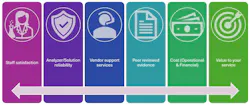
Every laboratory's evaluation will be shaped by its own context, but several considerations apply universally:
- Staff satisfaction: Is the system genuinely easy to use? What does the day-to-day experience look like for the people running it?
- System reliability: What Mean Time Between Failure data can the vendor provide, and how does it compare across the alternatives?
- Vendor support services: Does the vendor provide verification and validation support, lot rollover assistance, and troubleshooting? Is this evidenced, or simply promised?
- Publications and regulatory study data: What independent clinical and regulatory evidence supports the performance claims being made?
- Cost: Both operational and financial, assessed over the life of the system rather than at the point of acquisition.
- Value: What does this system deliver for the lab's hemostasis testing service, for the clinicians who rely on its results, and ultimately for the patients whose care depends on them?
Cost and value should always be evaluated together. A reliable system that supports staff and adapts to the lab’s evolving needs will deliver stronger long-term value, especially when backed by a partner committed to supporting its technology every step of the way.
About the Author
 Krishna Ram
Krishna Ram
is the Hemostasis Senior Product Manager at Sysmex America. He studied Biochemistry at the University of Nottingham and worked in numerous National Health Service Laboratories across England as a medical technologist before joining Sysmex.
 Christina Balsano